YUHINA
  • Home
  • Process
  • Outputs
  • Pricing
English▾
  • English
  • العربية
  • Français
  • Español
  • Deutsch
  • Português
  • Italiano
  • हिन्दी
  • 中文
  • 日本語
  • 한국어
  • Türkçe
  • Русский
  • Bahasa Indonesia
Sign in

How can we help?

Pick what it's about. The answer may already be below.

Something in the app isn't working the way it should.

My verification code hasn't arrived.+

YUHINA sends a 6-digit code to the address you signed up with. Check your spam or promotions folder. If it still isn't there after a few minutes, email support from that address.

Why can't I generate anything?+

You need a verified email first. A new account includes one free chapter with every output, once. After that, generating spends your plan's monthly usage or pay-as-you-go credit, so you need a plan or some credit to keep going.

My PDF gave weak results.+

Each PDF is one chapter, up to 60 pages. A digital PDF with text you can select gives the clearest lessons; blurry, dark, skewed or handwritten scans give weaker ones.

How do I delete my account or my files?+

The app's privacy notice explains how to export or permanently delete your account and everything in it. If something doesn't work, email support.

Still stuck? Email support, from the address on your account:

support@yuhina.ai

Buying for a school or a company? Talk to our enterprise team: enterprise@yuhina.ai

Sample library · Astronomy

The Sun: video lessons, quiz and flashcards from one textbook chapter

What YUHINA made from one astronomy chapter: 4 narrated video lessons with slides, 112 questions, 22 flashcards, a mind map and a podcast.

  • 4 lessons
  • 58 slides
  • 112 questions
  • 22 flashcards
  • 43-minute podcast

Generated by YUHINA on 2026-11-10 from a 20-page PDF and shown unedited.

Source: sections 15.1 to 15.3 of chapter 15, “The Sun: A Garden-Variety Star”, from Astronomy (1st edition) by Andrew Fraknoi, David Morrison et al., OpenStax, licensed CC BY 4.0. Astronomy. Access the book for free at openstax.org. Changes: YUHINA turned the text into lessons, slides, narration, questions, flashcards, a mind map and a podcast.

Try it with your own chapterSee pricing

The narrated video

The first 60 seconds of lesson 1. The chapter came out as 4 video lessons, about 37 minutes in all.

The first slides of lesson 1

  • Slide 1 of lesson 1
  • Slide 2 of lesson 1
  • Slide 3 of lesson 1

The lessons

YUHINA split the chapter into lessons. Each one has its own summary and quiz, shown below as generated.

Lesson 1: The Sun's Place and Composition: Basic Characteristics and Elemental Makeup

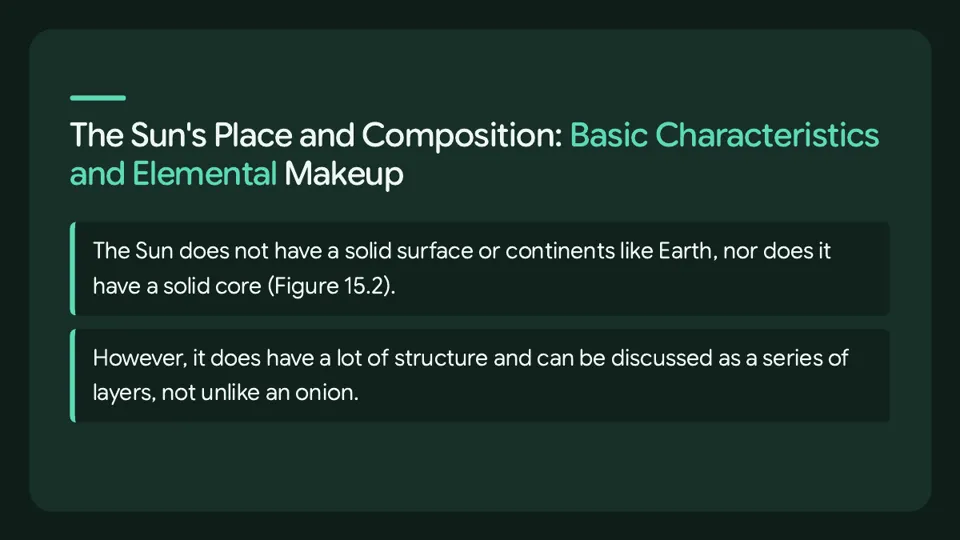
The Sun lacks a solid surface, continents like Earth, and a solid core, yet it has considerable structure and can be described as a series of layers, somewhat like an onion.

The makeup of the Sun is quite typical of stars in general, although it differs from that of our planet.

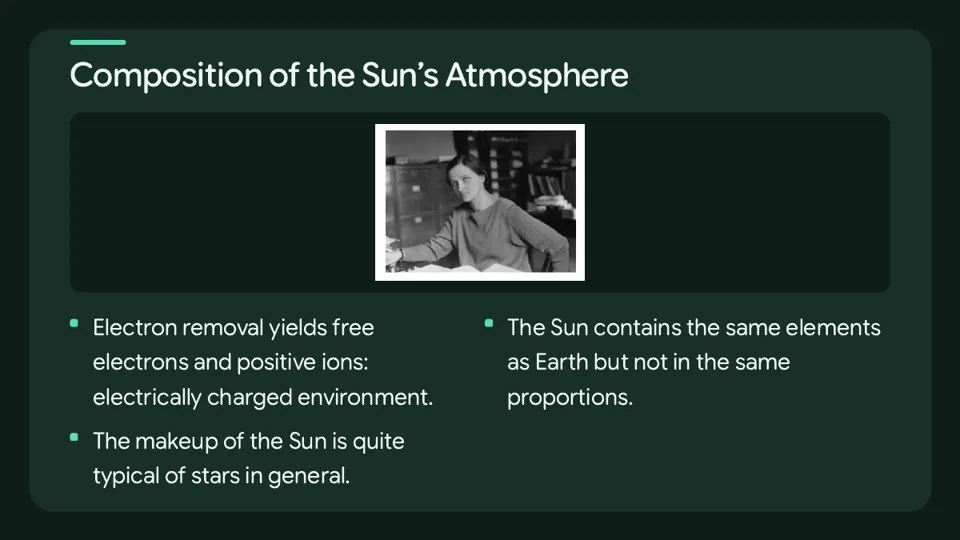
Cecilia Payne-Gaposchkin, the first woman to earn a PhD in astronomy in the United States, first showed in a brilliant 1925 thesis that our Sun and the stars have similar compositions and consist mostly of hydrogen and helium.

Before Payne-Gaposchkin’s work, everyone assumed that the composition of the Sun and stars would be much like that of Earth.

Most of the elements found in the Sun are in the form of atoms, with a small number of molecules, all in the form of gases: the Sun is so hot that no matter can survive as a liquid or a solid.

Composition of the Sun’s Atmosphere — selected points

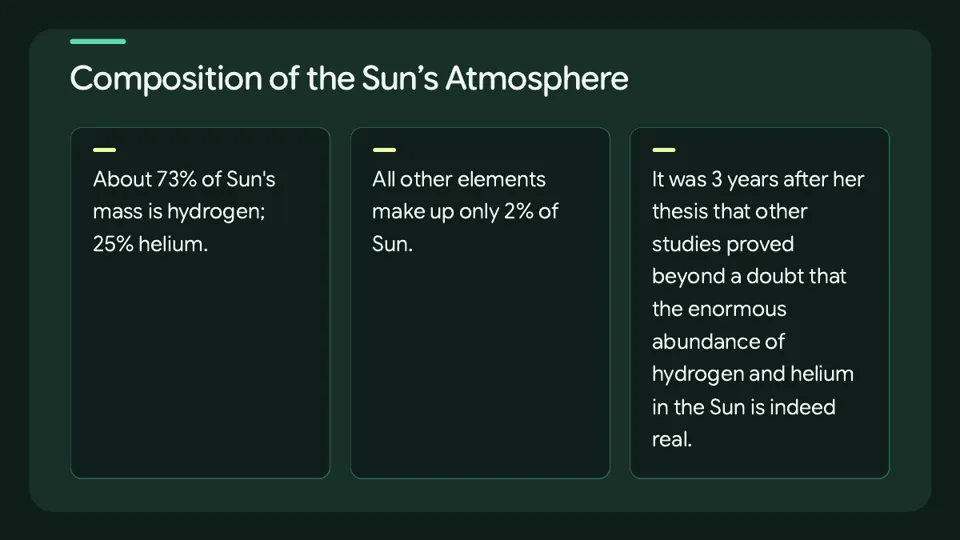
About 73% of the Sun's mass is hydrogen, and another 25% is helium.

All the other chemical elements, including carbon, oxygen, and nitrogen, make up only 2% of our star.

The Sun contains the same elements as Earth but not in the same proportions, and its makeup is quite typical of stars in general.

The Sun is so hot that many of its atoms are ionized, meaning they are stripped of one or more electrons, and scientists call such a hot ionized gas a plasma.

This removal of electrons from their atoms means that there is a large quantity of free electrons and positively charged ions in the Sun, making it an electrically charged environment—quite different from the neutral one in which you are reading this text.

The Layers of the Sun beneath the Visible Surface — selected points

The Sun's core is extremely dense and is the source of all of its energy.

The core is approximately 20% of the size of the solar interior and is thought to have a temperature of approximately 15 million K, making it the hottest part of the Sun.

The Solar Photosphere — selected points

Outside the Sun, we can observe only those photons that are emitted into the solar photosphere, where the density of atoms is sufficiently low and the photons can finally escape from the Sun without colliding with another atom or ion.

The energy that emerges from the photosphere was originally generated deep inside the Sun, and this energy is in the form of photons, which make their way slowly toward the solar surface.

Quiz (6 questions)

  1. “stripped of one or more of their electrons” — which term does this describe?

    • Ionized
    • Photosphere
    • Convective zone
    • Radiative zone
    Show the answer

    Ionized. Ionized means stripped of one or more electrons, leaving free electrons and positively charged ions. "Photosphere" is the visible surface layer where the Sun becomes opaque. "Convective zone" is the outermost layer of the solar interior where energy moves by convection cells. "Radiative zone" is the region above the core where energy travels by radiation.

  2. Which term matches this description: “the layer where the Sun becomes opaque and marks the boundary past which we cannot see”?

    • Radiative zone
    • Photosphere
    • Convective zone
    • Ionized
    Show the answer

    Photosphere. The photosphere is the layer where the Sun becomes opaque and marks the boundary past which we cannot see. "Radiative zone" is the region above the core where energy is transported by radiation. "Ionized" describes atoms stripped of electrons, not a layer. "Convective zone" is the outermost layer of the solar interior where energy moves by convection.

  3. True or false: The Sun contains the same elements as Earth but not in the same proportions.

    • True
    • False
    Show the answer

    True. The Sun contains the same elements as Earth but in very different proportions: about 73% of its mass is hydrogen and 25% is helium, while all other elements make up only 2%, unlike Earth's crust, which is dominated by oxygen, silicon, and aluminum.

  4. True or false: The radiative zone starts at about 25% of the distance to the solar surface and extends up to about 70% of the way to the surface.

    • True
    • False
    Show the answer

    True. The radiative zone starts at about 25% of the distance to the solar surface and extends up to about 70% of the way to the surface, lying above the core and below the convective zone.

  5. True or false: The makeup of the Sun is quite unusual compared with stars in general.

    • True
    • False
    Show the answer

    False. The makeup of the Sun is quite typical of stars in general, which are mostly hydrogen and helium, and is much more typical of the universe than Earth's odd concentration of heavier elements.

  6. Which statement defines “radiative zone”?

    • stripped of one or more of their electrons
    • the outermost layer of the solar interior
    • the layer where the Sun becomes opaque and marks the boundary past which we cannot see
    • the region above the core, named for the primary mode of transporting energy across it
    Show the answer

    the region above the core, named for the primary mode of transporting energy across it. The radiative zone is the region above the core, named for the primary mode of transporting energy across it, which is radiation. "Stripped of one or more of their electrons" defines ionized, not a zone. "The outermost layer of the solar interior" describes the convective zone. "The layer where the Sun becomes opaque and marks the boundary past which we cannot see" defines the photosphere.

Lesson 2: The Solar Photosphere and Granulation

The chromosphere appears reddish because one of the strongest emission lines in the visible part of its spectrum is a bright red line caused by hydrogen, the element that dominates the composition of the Sun.

Observations of the chromospheric spectrum revealed a yellow emission line that did not correspond to any previously known element on Earth.

The Chromosphere — selected points

The chromosphere is the region of the Sun's atmosphere that lies immediately above the photosphere.

Until this century, the chromosphere was visible only when the Moon concealed the photosphere during a total solar eclipse.

In the seventeenth century, several observers described what appeared to them as a narrow red streak or fringe around the edge of the Moon during a brief instant after the Sun's photosphere had been covered.

The name chromosphere, from the Greek for "colored sphere," was given to this red streak.

Observations made during eclipses show that the chromosphere is about 2000 to 3000 kilometers thick, and its spectrum consists of bright emission lines, indicating that this layer is composed of hot gases emitting light at discrete wavelengths.

The temperature of the chromosphere is about 10,000 K, which means that the chromosphere is hotter than the photosphere, a result that should seem surprising because in all familiar situations temperatures fall as one moves away from the source of heat and the chromosphere is farther from the center of the Sun than the photosphere is.

The Transition Region — selected points

Above the chromosphere is a region in the solar atmosphere where the temperature changes from 10,000 K, typical of the chromosphere, to nearly a million degrees.

The hottest part of the solar atmosphere, with a temperature of a million degrees or more, is called the corona, and the part of the Sun where the rapid temperature rise occurs is appropriately called the transition region.

The transition region is probably only a few tens of kilometers thick.

NASA launched the Interface Region Imaging Spectrograph (IRIS) to study the transition region and to understand better how and why this sharp temperature increase occurs.

IRIS is the first space mission able to obtain high spatial resolution images of the different features produced over this wide temperature range and to see how they change with time and location.

The layered picture of photosphere, chromosphere, transition region and corona describes the big picture fairly well, but the Sun's atmosphere is really more complicated, with hot and cool regions intermixed, as when clouds of carbon monoxide gas colder than 4000 K are found at the same height above the photosphere as the much hotter gas of the chromosphere.

The Corona — selected points

The corona is the outermost part of the Sun's atmosphere.

Like the chromosphere, the corona was first observed during total eclipses, but unlike the chromosphere, the corona has been known for many centuries: it was referred to by the Roman historian Plutarch and was discussed in some detail by Kepler.

The corona extends millions of kilometers above the photosphere and emits about half as much light as the full moon.

We do not see this light until an eclipse occurs because of the overpowering brilliance of the photosphere, just as bright city lights make it difficult to see faint starlight and the intense light from the photosphere hides the faint light from the corona.

The best time to see the corona from Earth is during a total solar eclipse, but the corona can be observed easily from orbiting spacecraft.

The brighter parts of the corona can now be photographed with a special instrument, a coronagraph, that removes the Sun's glare from the image with an occulting disk.

Studies of the corona's spectrum show the corona to be very low in density, and the corona thins out very rapidly at greater heights, where it corresponds to a high vacuum by Earth laboratory standards.

The corona extends so far into space, far past Earth, that here on our planet we are technically living in the Sun's atmosphere.

The Solar Wind — selected points

Solar wind particles flow outward from the Sun into the solar system at a speed of about 400 kilometers per second, almost 1 million miles per hour.

The solar wind exists because the gases in the corona are so hot and moving so rapidly that they cannot be held back by solar gravity.

Although the solar wind material is very, very rarified, that is, extremely low in density, the Sun has an enormous surface area, and astronomers estimate that the Sun is losing about 10 million tons of material each year through the solar wind.

While this amount of lost mass seems large by Earth standards, it is completely insignificant for the Sun.

The solar wind comes predominantly from coronal holes, where gas can stream away from the Sun into space unhindered by magnetic fields.

At the surface of Earth, we are protected to some degree from the solar wind by our atmosphere and Earth's magnetic field, but the magnetic field lines come into Earth at the north and south magnetic poles.

At the magnetic poles, charged particles accelerated by the solar wind can follow the field down into our atmosphere, and as the particles strike molecules of air they cause them to glow, producing beautiful curtains of light called the auroras, or the northern and southern lights.

(This wind was actually discovered by its effects on the charged tails of comets; in a sense, we can see the comet tails blow in the solar breeze the way wind socks at an airport or curtains in an open window flutter on Earth.)

Quiz (7 questions)

  1. Which term is defined as “the mottled structure of the photosphere”?

    • Coronal holes
    • Transition region
    • Granulation
    • Coronagraph
    Show the answer

    Granulation. Granulation is the term for the mottled structure of the photosphere, which appears as bright granules surrounded by darker regions. The transition region is the part of the Sun where the temperature rises rapidly, not a surface pattern. Coronal holes are large, dark, cool regions of the corona, not the photosphere's texture. A coronagraph is an instrument that blocks the Sun's glare, not a feature of the photosphere.

  2. Which term is defined as “the region of the Sun's atmosphere that lies immediately above the photosphere”?

    • Transition region
    • Coronal holes
    • Coronagraph
    • Chromosphere
    Show the answer

    Chromosphere. The chromosphere is the region of the Sun's atmosphere that lies immediately above the photosphere. The transition region is where the temperature rises rapidly, located above the chromosphere. Coronal holes are dark, cool regions of the corona, not the layer above the photosphere. A coronagraph is an instrument, not a layer of the Sun.

  3. Which term is defined as “the hottest part of the solar atmosphere, with a temperature of a million degrees or more”?

    • Granulation
    • Photosphere
    • Chromosphere
    • Corona
    Show the answer

    Corona. The corona is the hottest part of the solar atmosphere, with a temperature of a million degrees or more. Granulation is the mottled pattern on the photosphere, not a temperature region. The photosphere is the visible surface of the Sun and is much cooler than the corona. The chromosphere is a layer above the photosphere with a temperature of about 10,000 K, far below a million degrees.

  4. True or false: The solar wind comes predominantly from coronal holes, where gas streams away strongly hindered by magnetic fields.

    • True
    • False
    Show the answer

    False. The statement is false because the solar wind comes predominantly from coronal holes, where gas streams away unhindered by magnetic fields, not strongly hindered. In coronal holes, magnetic field lines stretch far out into space, allowing gas to escape freely. Hot coronal gas is present mainly where magnetic fields have trapped and concentrated it, but that is not where the solar wind predominantly originates.

  5. True or false: The centers of granules are hotter than the intergranular regions by 50 to 100 K.

    • True
    • False
    Show the answer

    True. Measurements show that the centers of granules are hotter than the intergranular regions by 50 to 100 K. This temperature difference is what makes the granules appear bright against the darker, cooler intergranular lanes. The statement is therefore true.

  6. True or false: Studies of its spectrum show the corona to be very high in density.

    • True
    • False
    Show the answer

    False. The statement is false because studies of its spectrum show the corona to be very low in density, not high. At the bottom of the corona, there are only about 10^9 atoms per cubic centimeter, compared with about 10^16 in the upper photosphere. The corona thins out very rapidly at greater heights, corresponding to a high vacuum by Earth laboratory standards.

  7. Which statement defines “transition region”?

    • the part of the Sun where the rapid temperature rise occurs
    • the region of the Sun's atmosphere that lies immediately above the photosphere
    • large dark regions of the corona that are relatively cool and quiet
    • the hottest part of the solar atmosphere, with a temperature of a million degrees or more
    Show the answer

    the part of the Sun where the rapid temperature rise occurs. The transition region is the part of the Sun where the rapid temperature rise occurs, between the chromosphere and the corona. Large dark regions of the corona that are relatively cool and quiet are coronal holes, not the transition region. The region immediately above the photosphere is the chromosphere. The hottest part of the solar atmosphere, with a temperature of a million degrees or more, is the corona.

Lesson 3: Sunspots, the Solar Cycle, and Solar Magnetism

The Sun is in a perpetual state of change, and its surface is a seething, bubbling cauldron of hot gas.

Occasionally, giant explosions on the Sun send enormous streamers of charged particles and energy hurtling toward Earth, and when they arrive, these can cause power outages and other serious effects on our planet.

Occasionally, sunspots are large enough to be visible to the unaided eye, and records going back over a thousand years exist from observers who noticed them when haze or mist reduced the Sun’s intensity.

Looking at the Sun for even a brief time can cause permanent eye damage.

Individual sunspots come and go, with lifetimes that range from a few hours to a few months, and frequently spots occur in groups of 2 to 20 or more, with the largest groups being very complex and possibly having over 100 spots.

Like storms on Earth, sunspots are not fixed in position but drift slowly compared with the Sun’s rotation.

During sunspot minima, sometimes no spots are visible.

Whenever sunspots are observed in pairs or in groups containing two principal spots, one of the spots usually has the magnetic polarity of a north-seeking magnetic pole and the other has the opposite polarity, but during the next sunspot cycle, the polarity of the leading spots is reversed in each hemisphere.

Astronomers have found that the Sun’s dynamo generates the magnetic field, and in the Sun, the source of kinetic energy is the churning of turbulent layers of ionized gas within the Sun’s interior.

As the magnetic fields from the Sun’s dynamo interact, they break, reconnect, and rise through the Sun’s surface, and when a large loop emerges from the solar surface, it creates regions of sunspot activity, with the leading sunspot coinciding with one end of the loop and the trailing spot with the other end.

Researchers have not yet developed a generally accepted model that describes in detail the physical processes that control the solar cycle, but calculations do show that differential rotation and convection just below the solar surface can twist and distort the magnetic fields.

Our star turns in a west-to-east direction, like the orbital motions of the planets.

The solar magnetic field is measured using a property of atoms called the Zeeman effect.

In the presence of a strong magnetic field, however, each energy level is separated into several levels very close to one another. The separation of the levels is proportional to the strength of the field.

Measurements of the Zeeman effect in the spectra of the light from sunspot regions show them to have strong magnetic fields (Figure 15.15).

Magnetic fields also hold the key to explaining why sunspots are cooler and darker than the regions without strong magnetic fields.

The forces produced by the magnetic field resist the motions of the bubbling columns of rising hot gases.

Since these columns carry most of the heat from inside the Sun to the surface by means of convection, and strong magnetic fields inhibit this convection, the surface of the Sun is allowed to cool.

As a result, these regions are seen as darker, cooler sunspots.

Sunspots

The first evidence that the Sun changes came from studies of sunspots, which are large, dark features seen on the surface of the Sun caused by increased magnetic activity.

Sunspots look darker because they are typically at a temperature of about 3800 K, whereas the bright regions that surround them are at about 5800 K.

Although sunspots look darker because they are cooler, they are nevertheless hotter than the surfaces of many stars, and if they could be removed from the Sun, they would shine brightly, appearing dark only in contrast with the hotter, brighter photosphere around them.

If a spot lasts and develops, it usually consists of two parts: an inner darker core, the umbra, and a surrounding less dark region, the penumbra.

Many spots become much larger than Earth, and a few have reached diameters over 140,000 kilometers.

By recording the apparent motions of the sunspots as the turning Sun carried them across its disk (Figure 15.14), Galileo, in 1612, demonstrated that the Sun rotates on its axis with a rotation period of approximately 1 month.

The Sun, however, is a gas and does not have to rotate rigidly, the way a solid body like Earth does.

The rotation period is about 25 days at the equator, 28 days at latitude 40°, and 36 days at latitude 80°. We call this behavior differential rotation.

The Sunspot Cycle

Heinrich Schwabe, a German pharmacist and amateur astronomer, kept daily records of the number of sunspots between 1826 and 1850.

Schwabe was really looking for a planet inside the orbit of Mercury, which he hoped to find by observing its dark silhouette as it passed between the Sun and Earth.

Schwabe failed to find the hoped-for planet, but his diligence paid off with an even-more important discovery: the sunspot cycle.

Schwabe found that the number of sunspots varied systematically, in cycles about a decade long.

Schwabe observed that, although individual spots are short lived, the total number visible on the Sun at any one time was likely to be very much greater at certain times—the periods of sunspot maximum—than at other times—the periods of sunspot minimum.

Sunspot maxima occur at an average interval of 11 years, but the intervals between successive maxima have ranged from as short as 9 years to as long as 14 years, and the Sun’s activity reached its most recent maximum in 2014.

Magnetism and the Solar Cycle — selected points

Astronomers now understand that it is the Sun’s changing magnetic field that drives solar activity.

Spectral lines formed in the presence of a magnetic field are not single lines but a series of very closely spaced lines corresponding to the subdivisions of the atomic energy levels, and this splitting of lines in the presence of a magnetic field is what we call the Zeeman effect, after the Dutch scientist who first discovered it in 1896.

During a given cycle, the leading spots of pairs (or leading principle spots of groups) in the Northern Hemisphere all tend to have the same polarity, whereas those in the Southern Hemisphere all tend to have the opposite polarity.

Strictly speaking, the sunspot cycle does not repeat itself in regard to magnetic polarity until two 11-year cycles have passed.

A visual representation of the Sun’s magnetic fields, called a magnetogram, can be used to see the relationship between sunspots and the Sun’s magnetic field.

A dynamo is a machine that converts kinetic energy (i.e., the energy of motion) into electricity. Most solar researchers agree that the solar dynamo is located in the convection zone or in the interface layer between the convection zone and the radiative zone below it.

Calculations also show that as the fields grow stronger near solar maximum, they flow from the interior of the Sun toward its surface in the form of loops.

Beyond this general picture, researchers are still trying to determine why the magnetic fields are as large as they are, why the polarity of the field in each hemisphere flips from one cycle to the next, why the length of the solar cycle can vary from one cycle to the next, and why events like the Maunder Minimum occur.

For example, if during one cycle, the leading spots in the Northern Hemisphere all had the polarity of a northseeking pole, then the leading spots in the Southern Hemisphere would have the polarity of a south-seeking pole.

During the next cycle, the leading spots in the Northern Hemisphere would have south-seeking polarity, whereas those in the Southern Hemisphere would have north-seeking polarity.

SOLAR ACTIVITY ABOVE THE PHOTOSPHERE

Sunspots are not the only features that vary during a solar cycle, as there are dramatic changes in the chromosphere and corona as well.

Quiz (6 questions)

  1. “large, dark features seen on the surface of the Sun caused by increased magnetic activity” — which term does this describe?

    • Differential rotation
    • Sunspots
    • Magnetogram
    • Sunspot cycle
    Show the answer

    Sunspots. Sunspots are large, dark features on the Sun's surface caused by increased magnetic activity. Differential rotation is the Sun rotating at different rates at different latitudes, not a dark feature. A magnetogram is a visual representation of the Sun's magnetic fields, not a dark feature on the surface. The sunspot cycle is the periodic variation in the number of sunspots, not the spots themselves.

  2. Which term matches this description: “the splitting of spectral lines in the presence of a magnetic field”?

    • Dynamo
    • Penumbra
    • Zeeman effect
    • Sunspots
    Show the answer

    Zeeman effect. The Zeeman effect is the splitting of spectral lines in the presence of a magnetic field, with the separation proportional to the field strength. The penumbra is the less dark outer region of a sunspot, not a spectral phenomenon. A dynamo is a machine that converts kinetic energy into electricity, not a spectral effect. Sunspots are dark features on the Sun's surface, not the splitting of spectral lines.

  3. What does “magnetogram” mean?

    • large, dark features seen on the surface of the Sun caused by increased magnetic activity
    • A machine that converts kinetic energy (the energy of motion) into electricity.
    • A visual representation of the Sun’s magnetic fields, used to see the relationship between sunspots and the Sun’s magnetic field.
    • the splitting of spectral lines in the presence of a magnetic field
    Show the answer

    A visual representation of the Sun’s magnetic fields, used to see the relationship between sunspots and the Sun’s magnetic field.. A magnetogram is a visual representation of the Sun's magnetic fields, used to see the relationship between sunspots and the Sun's magnetic field. Large, dark features caused by increased magnetic activity are sunspots, not a magnetogram. A machine that converts kinetic energy into electricity is a dynamo, not a magnetogram. The splitting of spectral lines in a magnetic field is the Zeeman effect, not a magnetogram.

  4. True or false: Because the Sun spins faster near the poles than at the equator, the magnetic fields in the Sun tend to wind up and after a while make loops.

    • True
    • False
    Show the answer

    False. The statement is false because the Sun spins faster at the equator than near the poles, not faster near the poles. This differential rotation, together with convection, twists and distorts the magnetic fields so that they wind up and eventually form loops.

  5. True or false: Magnetic fields explain why sunspots are cooler and darker than regions without strong magnetic fields.

    • True
    • False
    Show the answer

    True. The statement is true because the forces produced by the magnetic field resist the rising columns of hot gas, inhibiting convection that carries most of the heat to the surface. As a result, the surface is allowed to cool, so these regions appear darker and cooler than regions without strong magnetic fields.

  6. True or false: In a strong magnetic field each atomic energy level is separated into several closely spaced levels, and the separation is proportional to the strength of the field.

    • True
    • False
    Show the answer

    True. The statement is true because in a strong magnetic field each atomic energy level splits into several closely spaced levels, and the separation of these levels is proportional to the strength of the field. This splitting produces a series of closely spaced spectral lines, an effect used to measure the solar magnetic field.

Lesson 4: Solar Activity: Plages, Prominences, Flares, and Coronal Mass Ejections

Pictures taken through special filters reveal bright clouds in the chromosphere around sunspots, and these bright regions are called plages.

Plages contain all of the elements in the Sun, not only hydrogen and calcium.

Prominences are spectacular phenomena that usually originate near sunspots.

Quiescent prominences are graceful loops of plasma, that is, ionized gas, and they can remain nearly stable for many hours or even days.

Eruptive prominences are relatively rare and appear to send matter upward into the corona at high speeds.

A solar flare is the most violent event on the surface of the Sun, a rapid eruption; the largest flares last for several hours and emit enough energy to power the entire United States at its current rate of electrical consumption for 100,000 years.

Near sunspot maximum, small flares occur several times per day, and major ones may occur every few weeks.

At the moment of the explosion, the matter associated with the flare is heated to temperatures as high as 10 million K.

At such high temperatures, a flood of X-ray and ultraviolet radiation is emitted.

Flares seem to occur when magnetic fields pointing in opposite directions release energy by interacting with and destroying each other—much as a stretched rubber band releases energy when it breaks.

Plages and Prominences

Plages are regions within the chromosphere that have higher temperature and density than their surroundings.

The most active surge prominences may move as fast as 1300 kilometers per second, almost 3 million miles per hour, and some eruptive prominences have reached heights of more than 1 million kilometers above the photosphere, so that Earth would be completely lost inside one of those awesome displays.

Flares and Coronal Mass Ejections — selected points

A typical flare lasts for 5 to 10 minutes and releases a total amount of energy equivalent to that of perhaps a million hydrogen bombs.

In some cases, immense quantities of coronal material, mainly protons and electrons, may also be ejected at high speeds of 500–1000 kilometers per second into interplanetary space, and such a coronal mass ejection can affect Earth in a number of ways.

Active Regions

Astronomers now realize that sunspots, flares, and bright regions in the chromosphere and corona tend to occur together on the Sun in time and space, meaning that they all tend to have similar longitudes and latitudes but are located at different heights in the atmosphere.

Because they all occur together, they vary with the sunspot cycle.

Quiz (5 questions)

  1. Which term is defined as “graceful loops of plasma (ionized gas) that can remain nearly stable for many hours or even days”?

    • Solar flare
    • Quiescent prominences
    • Zeeman effect
    • Eruptive prominences
    Show the answer

    Quiescent prominences. Quiescent prominences are graceful loops of plasma that can remain nearly stable for many hours or even days. A solar flare is a rapid, violent eruption lasting minutes to hours, not a stable loop. The Zeeman effect is the splitting of spectral lines by magnetic fields, not a prominence type. Eruptive prominences send matter upward into the corona at high speeds and are not described as stable for hours or days.

  2. True or false: Flares seem to occur when magnetic fields pointing in the same direction release energy by interacting with and destroying each other.

    • True
    • False
    Show the answer

    False. Flares seem to occur when magnetic fields pointing in opposite directions release energy by interacting with and destroying each other, much like a stretched rubber band releasing energy when it breaks. The statement says the fields point in the same direction, which is incorrect.

  3. True or false: Plages contain all of the elements in the Sun, not just hydrogen and calcium.

    • True
    • False
    Show the answer

    True. Plages contain all of the elements in the Sun, not just hydrogen and calcium; their higher temperature and density make the hydrogen and calcium lines bright and easy to observe. The statement is therefore true.

  4. True or false: Near sunspot maximum, small flares occur several times per day, and major ones may occur every few weeks.

    • True
    • False
    Show the answer

    True. Near sunspot maximum, small flares occur several times per day, and major ones may occur every few weeks. The statement accurately describes this pattern.

  5. True or false: Because sunspots, flares, and bright regions occur together, they remain constant throughout the sunspot cycle.

    • True
    • False
    Show the answer

    False. Sunspots, flares, and bright regions tend to occur together in time and space, forming active regions, but because they all occur together, they vary with the sunspot cycle rather than remaining constant. The statement is therefore false.

Flashcards

  • ionized

    stripped of one or more of their electrons

  • radiative zone

    the region above the core, named for the primary mode of transporting energy across it

  • convective zone

    the outermost layer of the solar interior

  • photosphere

    the layer where the Sun becomes opaque and marks the boundary past which we cannot see

  • granulation

    the mottled structure of the photosphere

  • chromosphere

    the region of the Sun's atmosphere that lies immediately above the photosphere

  • corona

    the hottest part of the solar atmosphere, with a temperature of a million degrees or more

  • transition region

    the part of the Sun where the rapid temperature rise occurs

  • coronagraph

    a special instrument that removes the Sun’s glare from the image with an occulting disk

  • coronal holes

    large dark regions of the corona that are relatively cool and quiet

  • sunspots

    large, dark features seen on the surface of the Sun caused by increased magnetic activity

  • penumbra

    the surrounding less dark region of a sunspot

  • differential rotation

    the behavior in which the speed of rotation of the Sun varies according to latitude

  • sunspot cycle

    the systematic variation in the number of sunspots, in cycles about a decade long

  • Zeeman effect

    the splitting of spectral lines in the presence of a magnetic field

  • magnetogram

    A visual representation of the Sun’s magnetic fields, used to see the relationship between sunspots and the Sun’s magnetic field.

  • dynamo

    A machine that converts kinetic energy (the energy of motion) into electricity.

  • plages

    Pictures taken through these special filters show bright “clouds” in the chromosphere around sunspots; these bright regions are known as plages

  • prominences

    we come to the spectacular phenomena called prominences (Figure 15.19), which usually originate near sunspots

  • quiescent prominences

    graceful loops of plasma (ionized gas) that can remain nearly stable for many hours or even days

  • eruptive prominences

    relatively rare prominences that appear to send matter upward into the corona at high speeds

  • solar flare

    the most violent event on the surface of the Sun, a rapid eruption

Mind map

1

  • The structure and composition of the sun

    • Composition of the Sun’s Atmosphere
      • hydrogen
      • helium
    • The Layers of the Sun beneath the Visible Surface
      • core
      • radiative zone
      • convective zone
      • convection cells
    • The Solar Photosphere
      • photosphere
      • granulation
      • granules
      • supergranules
      • intergranular regions
    • The Chromosphere
      • chromosphere
      • bright emission lines
    • The Transition Region
      • transition region
      • Interface Region Imaging Spectrograph (IRIS)
    • The Corona
      • coronagraph
      • occulting disk
  • The Solar Wind

    • solar wind
    • coronal holes
    • auroras
  • The solar cycle

    • Sunspots
      • umbra
      • penumbra
    • The Sunspot Cycle
      • sunspot cycle
      • sunspot maximum
      • sunspot minimum
    • Magnetism and the Solar Cycle
      • Zeeman effect
      • magnetogram
      • dynamo
      • magnetic loops
  • Solar activity above the photosphere

    • Plages and Prominences
      • plages
      • prominences
      • quiescent prominences
      • eruptive prominences
      • surge prominences
    • Flares and Coronal Mass Ejections
      • solar flare
      • coronal mass ejection (CME)
    • Active Regions

The podcast

The first 90 seconds of a 43-minute episode about the whole chapter. How it opens:
host
Welcome to the episode. I am glad you are joining us, because today we are turning our attention to the Sun itself — its place among the stars and what it is actually made of. To help me unpack this, I have an expert with me. Thank you for being here.
guest
Thank you for having me. It is a pleasure to be here, and it is a wonderful topic to open with, because the Sun is both utterly familiar and surprisingly strange once we look closely.
host
Let us start with something basic. What is the Sun, really?
guest
The Sun is an enormous ball of extremely hot, largely ionized gas that shines under its own power. It is a star, and like all stars it is a self-luminous ball of hot gas rather than a solid body like Earth. So it has no solid surface and no continents, and it does not have a solid core either.
host
If there is no solid surface and no solid core, how should we picture its interior? Is it just uniform throughout?
guest
Not at all. The Sun does have a lot of structure, and we can describe it as a series of layers, somewhat like an onion. Picture an onion with many distinct layers from the center to the outside, each one different from the others. Each layer plays a part in producing the Sun's energy.

Source: sections 15.1 to 15.3 of chapter 15, “The Sun: A Garden-Variety Star”, from Astronomy (1st edition) by Andrew Fraknoi, David Morrison et al., OpenStax, licensed CC BY 4.0. Astronomy. Access the book for free at openstax.org. Changes: YUHINA turned the text into lessons, slides, narration, questions, flashcards, a mind map and a podcast.

Try it with your own chapterSee pricing

More samples

  • Psychology

    Memory

    3 lessons · 57 slides · 124 questions · 26 flashcards · 25-minute podcast

  • Biology

    Cell Structure

    4 lessons · 55 slides · 115 questions · 32 flashcards · 37-minute podcast

  • Chemistry

    Atoms, Molecules, and Ions

    4 lessons · 54 slides · 112 questions · 17 flashcards · 37-minute podcast

  • Anatomy and Physiology

    Heart Anatomy

    4 lessons · 60 slides · 110 questions · 32 flashcards · 43-minute podcast

  • Physics

    Forces and Newton’s Laws of Motion

    4 lessons · 63 slides · 112 questions · 18 flashcards · 44-minute podcast

  • American Government

    The Constitution and Its Origins

    3 lessons · 82 slides · 104 questions · 15 flashcards · 55-minute podcast

  • Sociology

    Culture

    2 lessons · 86 slides · 89 questions · 20 flashcards · 50-minute podcast

  • Economics

    Demand and Supply

    4 lessons · 50 slides · 114 questions · 22 flashcards · 36-minute podcast

All samples
YUHINA

One chapter in. A whole course out.

YUHINA generates the teaching content around your source material — narrated video, question banks, slide decks, podcasts, mind maps and flash cards, all from the same text.

Questions?

Support
support@yuhina.ai
General inquiries
hello@yuhina.ai
Enterprise
enterprise@yuhina.ai

Explore

  • Home
  • Process
  • Outputs
  • Pricing
  • Compare
  • Samples
  • Documentation
  • Contact
  • Get started
  • Sign in
  • Enterprise
  • YouTube
  • X

What it generates

  • PDF to video
  • PDF to quiz
  • PDF to flash cards
  • PDF to podcast
  • PDF to mind map
  • PDF summary

Who it's for

  • Teachers
  • Students
  • Trainers
  • Tutoring centres

Legal

  • Terms
  • Privacy
  • Refunds
  • AI disclosure
  • Accessibility
  • Subprocessors
  • Security
  • This site's privacy notice

© 2026 YUHINA. All rights reserved.

Back to top

YUHINA