YUHINA
  • Home
  • Process
  • Outputs
  • Pricing
English▾
  • English
  • العربية
  • Français
  • Español
  • Deutsch
  • Português
  • Italiano
  • हिन्दी
  • 中文
  • 日本語
  • 한국어
  • Türkçe
  • Русский
  • Bahasa Indonesia
Sign in

How can we help?

Pick what it's about. The answer may already be below.

Something in the app isn't working the way it should.

My verification code hasn't arrived.+

YUHINA sends a 6-digit code to the address you signed up with. Check your spam or promotions folder. If it still isn't there after a few minutes, email support from that address.

Why can't I generate anything?+

You need a verified email first. A new account includes one free chapter with every output, once. After that, generating spends your plan's monthly usage or pay-as-you-go credit, so you need a plan or some credit to keep going.

My PDF gave weak results.+

Each PDF is one chapter, up to 60 pages. A digital PDF with text you can select gives the clearest lessons; blurry, dark, skewed or handwritten scans give weaker ones.

How do I delete my account or my files?+

The app's privacy notice explains how to export or permanently delete your account and everything in it. If something doesn't work, email support.

Still stuck? Email support, from the address on your account:

support@yuhina.ai

Buying for a school or a company? Talk to our enterprise team: enterprise@yuhina.ai

Sample library · Chemistry

Atoms, Molecules, and Ions: video lessons, quiz and flashcards from one textbook chapter

What YUHINA made from one chemistry chapter: 4 narrated video lessons with slides, 112 questions, 17 flashcards, a mind map and a podcast.

  • 4 lessons
  • 54 slides
  • 112 questions
  • 17 flashcards
  • 37-minute podcast

Generated by YUHINA on 2026-11-10 from a 18-page PDF and shown unedited.

Source: sections 2.1 to 2.3 of chapter 2, “Atoms, Molecules, and Ions”, from Chemistry (1st edition) by Paul Flowers, William R. Robinson et al., OpenStax, licensed CC BY 4.0. Chemistry. Access the book for free at openstax.org. Changes: YUHINA turned the text into lessons, slides, narration, questions, flashcards, a mind map and a podcast.

Try it with your own chapterSee pricing

The narrated video

The first 60 seconds of lesson 1. The chapter came out as 4 video lessons, about 40 minutes in all.

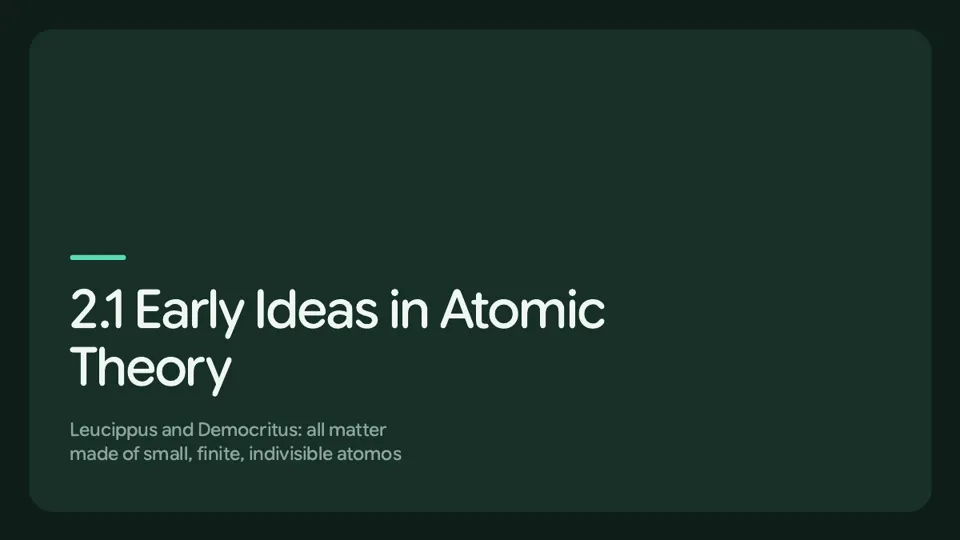
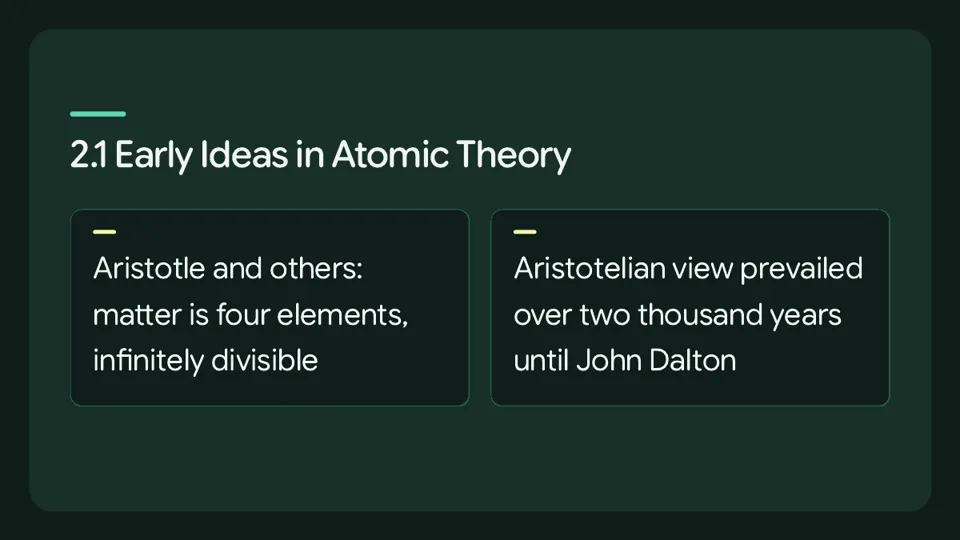
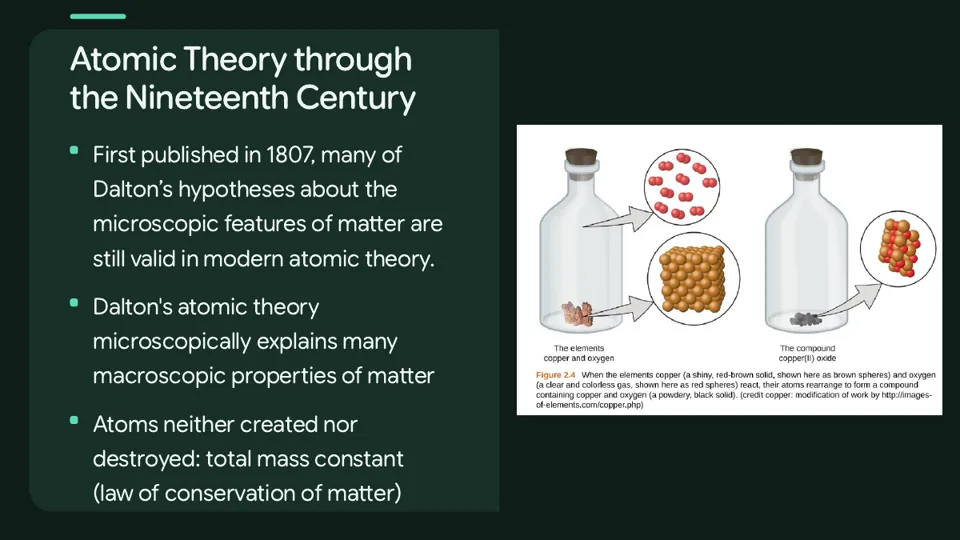
The first slides of lesson 1

  • Slide 1 of lesson 1
  • Slide 2 of lesson 1
  • Slide 3 of lesson 1

The lessons

YUHINA split the chapter into lessons. Each one has its own summary and quiz, shown below as generated.

Lesson 1: Dalton's Atomic Theory and the Laws of Definite and Multiple Proportions

The Aristotelian view of the composition of matter held sway for over two thousand years, until English schoolteacher John Dalton helped to revolutionize chemistry with his hypothesis that the behavior of matter could be explained using an atomic theory.

Matter is composed of exceedingly small particles called atoms, and an atom is the smallest unit of an element that can participate in a chemical change.

An element consists of only one type of atom, which has a mass that is characteristic of the element and is the same for all atoms of that element.

A compound consists of atoms of two or more elements combined in a small, whole-number ratio. In a given compound, the numbers of atoms of each of its elements are always present in the same ratio (Figure 2.3).

Atoms are neither created nor destroyed during a chemical change, but are instead rearranged to yield substances that are different from those present before the change (Figure 2.4).

Atomic Theory through the Nineteenth Century — selected points

First published in 1807, many of Dalton's hypotheses about the microscopic features of matter are still valid in modern atomic theory.

Dalton's atomic theory provides a microscopic explanation of the many macroscopic properties of matter that you've learned about.

If atoms are neither created nor destroyed during a chemical change, then the total mass of matter present when matter changes from one type to another will remain constant, which is the law of conservation of matter.

Dalton knew of the experiments of French chemist Joseph Proust, who demonstrated that all samples of a pure compound contain the same elements in the same proportion by mass, a statement known as the law of definite proportions or the law of constant composition.

The suggestion that the numbers of atoms of the elements in a given compound always exist in the same ratio is consistent with these observations; for example, when different samples of isooctane are analyzed, they are found to have a carbon-to-hydrogen mass ratio of 5.33:1.

Constant Composition of Isooctane

Sample A contains 14.82 g carbon and 2.78 g hydrogen, Sample B contains 22.33 g carbon and 4.19 g hydrogen, and Sample C contains 19.40 g carbon and 3.64 g hydrogen, with each sample showing a ratio of 5.33:1.

Example 2.2 — selected points

The ratio of these ratios is 1.33 g O per 1 g C divided by 2.67 g O per 1 g C = 1/2, which supports the law of multiple proportions.

This means that A and B are different compounds, with A having one-half as much oxygen per amount of carbon (or twice as much carbon per amount of oxygen) as B.

A possible pair of compounds that would fit this relationship would be A = CO and B = CO_2.

Quiz (6 questions)

  1. True or false: Chemical formulas depict molecules as well as the composition of compounds.

    • True
    • False
    Show the answer

    True. Chemical formulas show both the composition of compounds and the molecules they form. The statement is therefore true.

  2. True or false: postulates of Dalton’s atomic theory: An element consists of only one type of atom, which has a mass that is characteristic of the element and is the same for all atoms of that element

    • True
    • False
    Show the answer

    True. Dalton's theory states that an element consists of only one type of atom, and that this atom has a characteristic mass that is the same for all atoms of the element. The statement is therefore true.

  3. True or false: Chemical symbols are used to represent atoms and elements.

    • True
    • False
    Show the answer

    True. Chemical symbols are the shorthand used to represent atoms and elements. The statement is therefore true.

  4. True or false: postulates of Dalton’s atomic theory: Atoms are neither created nor destroyed during a chemical change, but are instead rearranged to yield substances that are different from those present before the change

    • True
    • False
    Show the answer

    True. Dalton's theory says atoms are neither created nor destroyed in a chemical change; they are rearranged to form different substances. The statement is therefore true.

  5. True or false: postulates of Dalton’s atomic theory: Atoms of one element differ in properties from atoms of all other elements.

    • True
    • False
    Show the answer

    True. Dalton's theory holds that atoms of one element differ in properties from atoms of every other element. The statement is therefore true.

  6. Which of the following statements is correct?

    • In a given compound, the numbers of atoms of each of its elements are always present in different ratios.
    • Chemical equations provide information about the quality and quantity of the changes associated with chemical reactions.
    • Matter is composed of exceedingly large particles called atoms.
    • An element consists of multiple types of atoms, which have a mass that is characteristic of the element and is the same for all atoms of that element
    Show the answer

    Chemical equations provide information about the quality and quantity of the changes associated with chemical reactions.. Chemical equations convey both the quality and the quantity of the changes in a chemical reaction. The statement that a compound always has its elements in different ratios is wrong, because the ratio is always the same. The statement that matter is made of exceedingly large particles called atoms is wrong, because atoms are exceedingly small. The statement that an element consists of multiple types of atoms is wrong, because an element has only one type of atom.

Lesson 2: Discovery of the Electron: Thomson's Cathode Ray Tube and Millikan's Oil Drop Experiments

A cathode ray tube is a sealed glass tube from which almost all the air has been removed and which contains two metal electrodes.

When high voltage is applied across the electrodes, a visible beam called a cathode ray appears between them.

In similar experiments, the ray was simultaneously deflected by an applied magnetic field, and measurements of the extent of deflection and the magnetic field strength allowed Thomson to calculate the charge-to-mass ratio of the cathode ray particles.

The electron is a negatively charged, subatomic particle with a mass more than one thousand-times less than that of an atom.

In 1909, more information about the electron was uncovered by American physicist Robert A. Millikan via his “oil drop” experiments.

Millikan created microscopic oil droplets, which could be electrically charged by friction as they formed or by using X-rays; these droplets initially fell due to gravity, but their downward progress could be slowed or even reversed by an electric field lower in the apparatus.

Millikan concluded that this value must therefore be a fundamental charge, namely the charge of a single electron, and that his measured charges were due to an excess of one electron, two electrons, three electrons, and so on, on a given oil droplet.

In 1904, Thomson proposed the “plum pudding” model of atoms, which described a positively charged mass with an equal amount of negative charge in the form of electrons embedded in it, since all atoms are electrically neutral.

Quiz (6 questions)

  1. True or false: Measurements of the extent of deflection and the magnetic field strength allowed Thomson to calculate the charge-to-mass ratio of the cathode ray particles.

    • True
    • False
    Show the answer

    True. Thomson measured how much the cathode ray was deflected by a magnetic field and used the field strength to calculate the charge-to-mass ratio of the particles. The statement is therefore true, not false.

  2. True or false: The cathode ray particles are less massive than atoms and indistinguishable regardless of source material, so they must be fundamental subatomic constituents of all atoms.

    • True
    • False
    Show the answer

    True. Because the cathode ray particles are less massive than atoms and are indistinguishable regardless of the source material, they must be fundamental, subatomic constituents of all atoms. The statement is therefore true, not false.

  3. True or false: By adjusting the electric field strength and making rough estimates without calculations, Millikan determined the charge on individual drops.

    • True
    • False
    Show the answer

    False. Millikan determined the charge on individual drops by adjusting the electric field strength and making careful measurements and appropriate calculations, not rough estimates without calculations. The statement is therefore false.

  4. Which of the following statements is correct?

    • When high voltage is applied across the electrodes of a cathode ray tube, a visible beam called a cathode ray appears between them.
    • In the late 1800s, J. J. Thomson made the most significant discovery using a cathode ray tube while investigating electrical discharges in high-pressure gases.
    • Rutherford performed experiments using a beam of high-speed, negatively charged alpha particles produced by the radioactive decay of radium.
    • In 1903, Hantaro Nagaoka postulated a Saturn-like atom consisting of a negatively charged sphere surrounded by a halo of electrons.
    Show the answer

    When high voltage is applied across the electrodes of a cathode ray tube, a visible beam called a cathode ray appears between them.. When high voltage is applied across the electrodes of a cathode ray tube, a visible beam called a cathode ray appears between them. Rutherford used high-speed, positively charged alpha particles, not negatively charged ones. Thomson investigated electrical discharges in low-pressure gases, not high-pressure gases. Nagaoka postulated a Saturn-like atom consisting of a positively charged sphere surrounded by a halo of electrons, not a negatively charged sphere.

  5. True or false: In 1904, Thomson proposed the plum pudding model of atoms, describing a positively charged mass with an equal amount of negative charge in the form of electrons embedded in it, since all atoms are electrically neutral.

    • True
    • False
    Show the answer

    True. In 1904, Thomson proposed the plum pudding model, describing a positively charged mass with an equal amount of negative charge in the form of electrons embedded in it, since all atoms are electrically neutral. The statement is therefore true, not false.

  6. What does “electron” mean?

    • A sealed glass tube from which almost all the air had been removed, containing two metal electrodes.
    • the smallest unit of an element that can participate in a chemical change
    • A negatively charged, subatomic particle with a mass more than one thousand-times less than that of an atom.
    • Particles that consist of two protons and two neutrons.
    Show the answer

    A negatively charged, subatomic particle with a mass more than one thousand-times less than that of an atom.. An electron is a negatively charged, subatomic particle with a mass more than one thousand times less than that of an atom. A sealed glass tube from which almost all the air had been removed, containing two metal electrodes, describes a cathode ray tube. The smallest unit of an element that can participate in a chemical change is the atom. Particles that consist of two protons and two neutrons are alpha particles.

Lesson 3: Rutherford's Nuclear Model and the Discovery of the Proton, Neutron, and Isotopes

When alpha particles struck the gold foil, most passed straight through, a few were deflected slightly, and a very small number were significantly deflected.

Because alpha particles carry a positive charge and like charges repel each other, the abrupt changes of path shown by a few positively charged alpha particles indicate that those particles hit, or closely approached, another body carrying a highly concentrated positive charge.

The deflections occurred only a small fraction of the time, so the positive charge responsible occupied only a small amount of the space in the gold foil, and the volume of an atom must therefore consist of a large amount of empty space.

A small, relatively heavy, positively charged body, the nucleus, must be at the center of each atom, and the nucleus contains the majority of an atom's mass because protons and neutrons are much heavier than electrons, whereas electrons occupy almost all of an atom's volume.

2.3 Atomic Structure and Symbolism — selected points

An atom contains a very small nucleus composed of positively charged protons and uncharged neutrons, surrounded by a much larger volume of space containing negatively charged electrons.

The diameter of an atom is on the order of 10^{−10} m, while the diameter of the nucleus is roughly 10^{−15} m, which is about 100,000 times smaller.

For tiny objects such as atoms, appropriately small units of measure are used, such as the atomic mass unit (amu) and the fundamental unit of charge (e).

The amu was originally defined based on hydrogen, the lightest element, and was later defined in terms of oxygen.

The fundamental unit of charge, also called the elementary charge, equals the magnitude of the charge of an electron, with e = 1.602 × 10^{−19} C.

A proton has a mass of 1.0073 amu and a charge of 1+, a neutron is a slightly heavier particle with a mass of 1.0087 amu and a charge of zero, and the electron has a charge of 1− and a mass of about 0.00055 amu, so it would take about 1800 electrons to equal the mass of one proton.

The number of protons in the nucleus is an atom's atomic number (Z), and the total number of protons and neutrons is its mass number (A), so the number of neutrons is the difference between the mass number and the atomic number (A − Z = number of neutrons).

Atoms and molecules typically acquire charge by gaining or losing electrons, so an atom that gains one or more electrons exhibits a negative charge and is called an anion, while positively charged atoms called cations are formed when an atom loses one or more electrons.

A neutral sodium atom (Z = 11) has 11 electrons, and if it loses one electron it becomes a cation with a 1+ charge (11 − 10 = 1+), whereas a neutral oxygen atom (Z = 8) has eight electrons, and if it gains two electrons it becomes an anion with a 2− charge (8 − 10 = 2−).

For example, any atom that contains six protons is the element carbon and has the atomic number 6, regardless of how many neutrons or electrons it may have.

Atoms are electrically neutral if they contain the same number of positively charged protons and negatively charged electrons.

When the numbers of these subatomic particles are not equal, the atom is electrically charged and is called an ion.

Atomic charge = number of protons − number of electrons

Example 2.3 Composition of an Atom

Iodine is an essential trace element in our diet and is needed to produce thyroid hormone.

Insufficient iodine in the diet can lead to the development of a goiter, an enlargement of the thyroid gland.

Properties of Subatomic Particles

The electron is located outside the nucleus, has a charge of −1.602 × 10^{−19} C (unit charge 1−), a mass of 0.00055 amu, and a mass of 0.00091 × 10^{−24} g.

The proton is located in the nucleus, has a charge of 1.602 × 10^{−19} C (unit charge 1+), a mass of 1.00727 amu, and a mass of 1.67262 × 10^{−24} g, while the neutron is located in the nucleus, has a charge of 0 (unit charge 0), a mass of 1.00866 amu, and a mass of 1.67493 × 10^{−24} g.

Example 2.3 Composition of an Atom

Adding small amounts of iodine to table salt (iodized salt) has essentially eliminated this health concern in the United States, but as much as 40% of the world's population is still at risk of iodine deficiency.

The iodine atoms are added as anions, each with a 1− charge and a mass number of 127, and the task is to determine the numbers of protons, neutrons, and electrons in one of these iodine anions.

The atomic number of iodine (53) tells us that a neutral iodine atom contains 53 protons in its nucleus and 53 electrons outside its nucleus, and because the sum of the numbers of protons and neutrons equals the mass number, 127, the number of neutrons is 74 (127 − 53 = 74).

Since the iodine is added as a 1− anion, the number of electrons is 54 [53 − (1−) = 54].

Chemical Symbols — selected points

A single symbol can serve both to indicate one atom of mercury in the microscopic domain and to label a container holding many atoms of the element mercury in the macroscopic domain.

Quiz (6 questions)

  1. “a small, relatively heavy, positively charged body at the center of each atom” — which term does this describe?

    • Anion
    • Nucleus
    • Cation
    • Chemical symbol
    Show the answer

    Nucleus. The nucleus is the small, relatively heavy, positively charged body at the center of each atom, so the description matches the nucleus. An anion is a negatively charged atom formed by gaining electrons, not a central body. A cation is a positively charged atom formed by losing electrons, not a central body. A chemical symbol is an abbreviation for an element or atom, not a physical structure.

  2. “atoms of the same element that differ in mass” — which term does this describe?

    • Chemical symbol
    • Anion
    • Isotopes
    • Proton
    Show the answer

    Isotopes. Isotopes are atoms of the same element that differ in mass, so the description matches isotopes. An anion is a negatively charged atom formed by gaining electrons, not a type of atom differing in mass. A chemical symbol is an abbreviation for an element or atom, not a class of atoms. A proton is a positively charged subatomic particle in the nucleus, not a type of atom.

  3. Which term is defined as “An atom that gains one or more electrons and exhibits a negative charge.”?

    • Nucleus
    • Cation
    • Proton
    • Anion
    Show the answer

    Anion. An anion is an atom that gains one or more electrons and exhibits a negative charge, so the definition matches anion. The nucleus is the central body of an atom containing protons and neutrons, not a charged atom. A cation is a positively charged atom formed by losing electrons, not a negatively charged one. A proton is a positively charged subatomic particle, not an atom with a negative charge.

  4. True or false: Adding small amounts of iodine to table salt has essentially eliminated the goiter health concern in the United States.

    • True
    • False
    Show the answer

    True. The addition of small amounts of iodine to table salt has essentially eliminated the goiter health concern in the United States, where salt consumption is high. The statement is therefore true. The false option would contradict this established outcome.

  5. True or false: A neutral atom must contain the same number of positive and negative charges, so the number of protons equals the number of electrons.

    • True
    • False
    Show the answer

    True. A neutral atom must contain the same number of positive and negative charges, so the number of protons equals the number of electrons. The statement is therefore true. The false option would contradict this balance.

  6. True or false: The same chemical symbol indicates one atom of an element or labels a container of many atoms of that element.

    • True
    • False
    Show the answer

    True. The same chemical symbol indicates one atom of an element or labels a container of many atoms of that element, so the statement is true. The false option would contradict this dual use.

Lesson 4: Chemical Symbols and Isotope Notation

Some element symbols come from the common name of the element, while other symbols are abbreviations of the name in another language.

Most symbols consist of one or two letters, but three-letter symbols have been used for some elements with atomic numbers greater than 112.

To avoid confusion with other notations, only the first letter of a symbol is capitalized; for example, Co is the symbol for cobalt, whereas CO is the notation for carbon monoxide, a compound containing carbon and oxygen atoms.

Traditionally, the discoverer or discoverers of a new element name the element.

The symbol for a specific isotope of an element is written by placing the mass number as a superscript to the left of the element symbol, and the atomic number is sometimes written as a subscript preceding the symbol but is often omitted because it defines the element’s identity along with the symbol.

Hydrogen-2, symbolized 2H, is also called deuterium and is sometimes symbolized D, while hydrogen-3, symbolized 3H, is also called tritium and is sometimes symbolized T.

Because each proton and each neutron contribute approximately one amu to the mass of an atom and each electron contributes far less, the atomic mass of a single atom is approximately equal to its mass number, a whole number.

However, the average masses of atoms of most elements are not whole numbers because most elements exist naturally as mixtures of two or more isotopes, and the mass shown in a periodic table or a table of atomic masses is a weighted average mass of all the isotopes present in a naturally occurring sample of that element.

Isotopes

For example, magnesium exists as a mixture of three isotopes, each with an atomic number of 12 and with mass numbers of 24, 25, and 26, respectively.

All magnesium atoms have 12 protons in their nucleus.

Magnesium atoms differ only because a 24Mg atom has 12 neutrons in its nucleus, a 25Mg atom has 13 neutrons, and a 26Mg atom has 14 neutrons.

These isotopes can be identified as 24Mg, 25Mg, and 26Mg.

These isotope symbols are read as “element, mass number” and can be symbolized consistent with this reading.

For instance, 24Mg is read as “magnesium 24,” and can be written as “magnesium-24” or “Mg-24.”

Atomic Mass — selected points

For example, boron is composed of two isotopes: about 19.9% of all boron atoms are 10B with a mass of 10.0129 amu, and the remaining 80.1% are 11B with a mass of 11.0093 amu.

boron average mass = (0.199 × 10.0129 amu) + (0.801 × 11.0093 amu) = 1.99 amu + 8.82 amu = 10.81 amu

It is important to understand that no single boron atom weighs exactly 10.8 amu; 10.8 amu is the average mass of all boron atoms, and individual boron atoms weigh either approximately 10 amu or 11 amu.

Example 2.4

A meteorite found in central Indiana contains traces of the noble gas neon picked up from the solar wind during the meteorite’s trip through the solar system.

Analysis of a sample of the gas showed that it consisted of 91.84% 20Ne (mass 19.9924 amu), 0.47% 21Ne (mass 20.9940 amu), and 7.69% 22Ne (mass 21.9914 amu).

average mass = (0.9184 × 19.9924 amu) + (0.0047 × 20.9940 amu) + (0.0769 × 21.9914 amu) = (18.36 + 0.099 + 1.69) amu = 20.15 amu

The average mass of a neon atom in the solar wind is 20.15 amu. (The average mass of a terrestrial neon atom is 20.1796 amu. This result demonstrates that we may find slight differences in the natural abundance of isotopes, depending on their origin.)

Quiz (6 questions)

  1. Which term matches this description: “An instrument used to experimentally determine the occurrence and natural abundances of isotopes.”?

    • Atomic number (Z)
    • Cathode ray tube
    • Electron
    • Mass spectrometer
    Show the answer

    Mass spectrometer. A mass spectrometer is the instrument used to determine the occurrence and natural abundances of isotopes experimentally. An atomic number (Z) is the number of protons in a nucleus, an electron is a subatomic particle, and a cathode ray tube is a device used in early studies of electrical discharge, not for isotope abundance measurement.

  2. Why is only the first letter of an element symbol capitalized?

    • To avoid confusion with other notations, such as the notation for a compound.
    • To show that the symbol comes from a Latin name rather than an English name.
    • To indicate that the element has an atomic number greater than 112.
    • To distinguish isotopes of the same element from one another.
    Show the answer

    To avoid confusion with other notations, such as the notation for a compound.. Capitalizing only the first letter of an element symbol avoids confusion with other notations, such as the notation for a compound like CO (carbon monoxide) versus Co (cobalt). The Latin origin of some symbols does not determine capitalization, atomic number greater than 112 does not affect capitalization, and isotopes are distinguished by mass number, not by capitalization.

  3. True or false: Mass spectrometry is widely used in chemistry, forensics, medicine, environmental science, and other fields to analyze and help identify substances in a sample.

    • True
    • False
    Show the answer

    True. Mass spectrometry is widely used in chemistry, forensics, medicine, environmental science, and other fields to analyze and help identify substances in a sample. This statement correctly describes its broad applications. The alternative would deny this established use.

  4. True or false: The atomic number is sometimes written as a subscript preceding the symbol, but it is often omitted because it defines the element's identity, as does its symbol.

    • True
    • False
    Show the answer

    True. The atomic number is sometimes written as a subscript preceding the symbol, but it is often omitted because it defines the element's identity, just as the symbol does. This statement accurately describes that convention. The alternative would contradict it.

  5. True or false: The symbol for a specific isotope of an element is written by placing the mass number as a superscript to the left of the element symbol.

    • True
    • False
    Show the answer

    True. The symbol for a specific isotope places the mass number as a superscript to the left of the element symbol. This statement correctly describes that notation. The alternative would misstate the position of the mass number.

  6. True or false: Isotope symbols are read as "element, mass number."

    • True
    • False
    Show the answer

    True. These isotope symbols are read as “element, mass number”

Flashcards

  • atom

    the smallest unit of an element that can participate in a chemical change

  • cathode ray tube

    A sealed glass tube from which almost all the air had been removed, containing two metal electrodes.

  • electron

    A negatively charged, subatomic particle with a mass more than one thousand-times less than that of an atom.

  • alpha particles (α particles)

    Particles that consist of two protons and two neutrons.

  • nucleus

    a small, relatively heavy, positively charged body at the center of each atom

  • proton

    the positively charged, subatomic particle found in the nucleus

  • isotopes

    atoms of the same element that differ in mass

  • neutrons

    uncharged, subatomic particles with a mass approximately the same as that of protons

  • number of neutrons

    A − Z = number of neutrons (A = mass number; Z = atomic number)

  • ion

    When the numbers of these subatomic particles are not equal, the atom is electrically charged and is called an ion.

  • atomic number (Z)

    The number of protons in the nucleus of an atom is its atomic number (Z).

  • anion

    An atom that gains one or more electrons and exhibits a negative charge.

  • cation

    A positively charged atom formed when an atom loses one or more electrons.

  • chemical symbol

    An abbreviation used to indicate an element or an atom of an element.

  • mass spectrometer

    An instrument used to experimentally determine the occurrence and natural abundances of isotopes.

  • Here is what Rutherford deduced

    Because most of the fast-moving α particles passed through the gold atoms undeflected, they must have traveled through essentially empty space inside the atom.

  • neutron

    nucleus; charge 0; unit charge 0; mass 1.00866 amu; mass 1.67493 × 10^{−24} g

Mind map

Chapter 2 | Atoms, Molecules, and Ions

  • Early Ideas in Atomic Theory

    • Atomic Theory through the Nineteenth Century
      • atomos
      • four "elements"
      • John Dalton
      • atomic theory
      • postulates of Dalton's atomic theory
        • Matter is composed of exceedingly small particles called atoms
        • An element consists of only one type of atom
        • Atoms of one element differ in properties
        • A compound consists of atoms of two or more elements
        • Atoms are neither created nor destroyed
  • Evolution of Atomic Theory

    • Atomic Theory after the Nineteenth Century
      • Thomson
      • cathode ray tube
      • cathode ray
      • charge-to-mass ratio
      • electron
      • Robert A. Millikan
      • fundamental charge
      • Hantaro Nagaoka
      • Saturn-like atom
      • Ernest Rutherford
      • alpha particles (α particles)
      • Hans Geiger
      • Ernest Marsden
      • gold foil
      • nucleus
      • proton
      • isotopes
      • Frederick Soddy
      • James Chadwick
      • neutrons
  • Atomic Structure and Symbolism

    • atomic mass unit (amu)
    • Properties of Subatomic Particles
      • neutron
    • atomic number (Z)
    • mass number (A)
    • ion
    • anion
    • cation
    • Atomic Mass
      • average mass

The podcast

The first 90 seconds of a 37-minute episode about the whole chapter. How it opens:
host
Welcome to our conversation on the early ideas that shaped atomic theory. I'm glad you're here with me today. Could you start by telling us what the very first atomic ideas were?
guest
In the fifth century BC, Leucippus and Democritus argued that all matter was composed of small, finite particles that they called atomos, a term derived from the Greek word for 'indivisible.' They thought of atoms as moving particles that differed in shape and size, and which could join together. These were philosophical concepts, not experimental conclusions.
host
What does that mean in practice—that these were philosophical concepts rather than experimental ones?
guest
It means the philosophers apparently never considered performing experiments to test their ideas. Imagine two groups of thinkers arguing about what a shadow is made of, but neither group ever tries to measure or test it. The lesson presents these as philosophical concepts from the fifth century BC and later, not as experimental conclusions.
host
And how did the view of matter change after that?
guest
Later, Aristotle and others came to the conclusion that matter consisted of various combinations of the four 'elements'—fire, earth, air, and water—and could be infinitely divided. The Aristotelian view of the composition of matter held sway for over two thousand years, until English schoolteacher John Dalton helped to revolutionize chemistry with his hypothesis that the behavior of matter could be explained using an atomic theory.

Source: sections 2.1 to 2.3 of chapter 2, “Atoms, Molecules, and Ions”, from Chemistry (1st edition) by Paul Flowers, William R. Robinson et al., OpenStax, licensed CC BY 4.0. Chemistry. Access the book for free at openstax.org. Changes: YUHINA turned the text into lessons, slides, narration, questions, flashcards, a mind map and a podcast.

Try it with your own chapterSee pricing

More samples

  • Psychology

    Memory

    3 lessons · 57 slides · 124 questions · 26 flashcards · 25-minute podcast

  • Biology

    Cell Structure

    4 lessons · 55 slides · 115 questions · 32 flashcards · 37-minute podcast

  • Anatomy and Physiology

    Heart Anatomy

    4 lessons · 60 slides · 110 questions · 32 flashcards · 43-minute podcast

  • Astronomy

    The Sun

    4 lessons · 58 slides · 112 questions · 22 flashcards · 43-minute podcast

  • Physics

    Forces and Newton’s Laws of Motion

    4 lessons · 63 slides · 112 questions · 18 flashcards · 44-minute podcast

  • American Government

    The Constitution and Its Origins

    3 lessons · 82 slides · 104 questions · 15 flashcards · 55-minute podcast

  • Sociology

    Culture

    2 lessons · 86 slides · 89 questions · 20 flashcards · 50-minute podcast

  • Economics

    Demand and Supply

    4 lessons · 50 slides · 114 questions · 22 flashcards · 36-minute podcast

All samples
YUHINA

One chapter in. A whole course out.

YUHINA generates the teaching content around your source material — narrated video, question banks, slide decks, podcasts, mind maps and flash cards, all from the same text.

Questions?

Support
support@yuhina.ai
General inquiries
hello@yuhina.ai
Enterprise
enterprise@yuhina.ai

Explore

  • Home
  • Process
  • Outputs
  • Pricing
  • Compare
  • Samples
  • Documentation
  • Contact
  • Get started
  • Sign in
  • Enterprise
  • YouTube
  • X

What it generates

  • PDF to video
  • PDF to quiz
  • PDF to flash cards
  • PDF to podcast
  • PDF to mind map
  • PDF summary

Who it's for

  • Teachers
  • Students
  • Trainers
  • Tutoring centres

Legal

  • Terms
  • Privacy
  • Refunds
  • AI disclosure
  • Accessibility
  • Subprocessors
  • Security
  • This site's privacy notice

© 2026 YUHINA. All rights reserved.

Back to top

YUHINA