
Lesson 1: Forces, Net Force, and Free-Body Diagrams
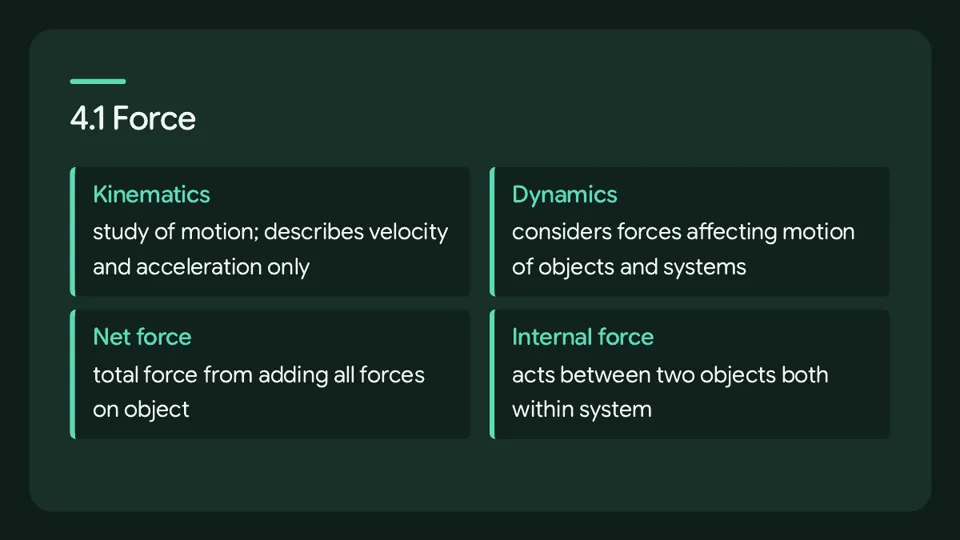
Kinematics is the study of motion and describes only the way objects move, including their velocity and acceleration.
Dynamics, by contrast, considers the forces that affect the motion of moving objects and systems.
The net force is the total force obtained by adding together all of the forces acting on an object.
An internal force acts between two objects that are both within the system, whereas the net external force is the total combined external force.
The usual convention is to make the positive directions right and up.
Correctly drawing and labeling a free-body diagram is an important first step for solving a problem.
Defining Force and Dynamics
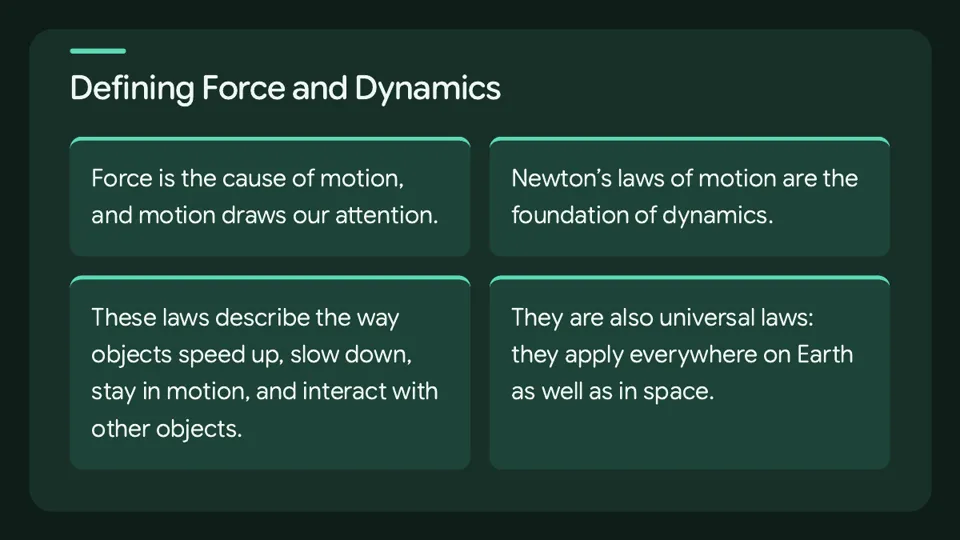
Force is the cause of motion, and motion draws our attention.
Newton’s laws of motion are the foundation of dynamics and describe the way objects speed up, slow down, stay in motion, and interact with other objects.
A force pushes or pulls an object, and forces have different magnitudes and directions, meaning that some forces are stronger than others and can act in different directions.
For example, a cannon exerts a strong force on the cannonball that is launched into the air, whereas a mosquito landing on your arm exerts only a small force on your arm.
An external force is a force that acts on an object within the system from outside the system.
Thus, a horizontal force of –3 N means pushing with 3 N to the left, and unknown values are taken to be in the positive direction, so if your calculation of a vertical force comes out as +5.2 N, then you know it is an upward force, while a negative result means the force is downward.
They are also universal laws: they apply everywhere on Earth as well as in space.
Like displacements, velocities, and accelerations, forces are vectors that have magnitude and direction.
We may represent a force as the sum of two vectors at right angles. These are its one-dimensional components, which we can represent by a signed scalar quantity.
When we do so, we must choose a coordinate system and the direction along each axis that will be the positive direction. This choice must be the same for all vectors in the problem—forces, accelerations, etc.
Commonly, in a problem set in a vertical plane, horizontal and vertical axes are chosen as the two primary directions. The usual convention is to make the positive directions right and up.
Sometimes a problem concerns a sloping plane, and it may be more convenient to choose axes parallel to the plane and normal to it. In this case, it is usual to take positive in each axis as the directions that tend upward.
Free-Body Diagrams and Examples of Forces — selected points
A free-body diagram represents the object being acted upon—that is, the free body—as a single point.
Only the forces acting on the body (that is, external forces) are shown and are represented by vectors, which are drawn as arrows, because only external forces acting on the body affect its motion.
We can ignore any internal forces within the body because they cancel each other out, as explained in the section on Newton’s third law of motion.
In a free-body diagram, the lengths of the arrows show the relative magnitude (or strength) of the forces, and because forces are vectors, they add just like other vectors.
Some forces act without physical contact, such as the pull of a magnet (in the case of magnetic force) or the gravitational pull of Earth (in the case of gravitational force).
To analyze situations involving forces, we will create free-body diagrams to organize the framework of the mathematics for each individual situation.
TIPS FOR SUCCESS
Correctly drawing and labeling a free-body diagram is an important first step for solving a problem, and it will help you visualize the problem and correctly apply the mathematics to solve the problem.
Newton’s First Law and Friction
Generally, friction is an external force that acts opposite to the direction of relative motion or to prevent slipping; when the friction prevents the object from sliding, it is called static friction.
Rolling resistance impedes the rolling of a wheel, and drag opposes and slows the motion of an object through a fluid.
Think of friction as a resistance to motion that slows things down.
Additionally, if we know enough about friction, we can accurately predict how quickly objects will slow down.
Consider an air hockey table. When the air is turned off, the puck slides only a short distance before friction slows it to a stop. However, when the air is turned on, it lifts the puck slightly, so the puck experiences very little friction as it moves over the surface. With friction almost eliminated, the puck glides along with very little change in speed.
Quiz (7 questions)
Which term matches this description: “Considers the forces that affect the motion of moving objects and systems.”?
- Dynamics
- Kinetic friction
- Internal force
- Kinematics
Show the answer
Dynamics. Dynamics considers the forces that affect the motion of moving objects and systems. Kinematics describes only the way objects move, in terms of velocity and acceleration, without considering forces. Kinetic friction is a force by a surface that opposes the motion of a sliding object, and an internal force acts between objects within a system. Neither of these is the study of forces affecting motion.
Which term is defined as “A force by a surface parallel to the surface that opposes the motion of a sliding object and causes it to slow down.”?
- Kinematics
- Kinetic friction
- Net external force
- Dynamics
Show the answer
Kinetic friction. Kinetic friction is a force by a surface parallel to the surface that opposes the motion of a sliding object and causes it to slow down. Kinematics is the study of motion without considering forces. Net external force is the total combined force acting on an object from outside its system, and dynamics is the study of forces that affect motion. None of these matches the description of a surface force opposing sliding.
Which term matches this description: “A force that opposes and slows the motion of an object through a fluid.”?
- Kinematics
- Dynamics
- Drag
- Net force
Show the answer
Drag. Drag is a force that opposes and slows the motion of an object through a fluid. Kinematics is the study of motion without considering forces. Dynamics is the study of forces that affect motion, and net force is the total force obtained by adding together all forces acting on an object. None of these is the force that slows an object moving through a fluid.
True or false: Correctly drawing and labeling a free-body diagram is an unimportant final step for solving a problem.
- True
- False
Show the answer
False. Correctly drawing and labeling a free-body diagram is an important first step for solving a problem, not an unimportant final step. A free-body diagram helps visualize the problem and correctly apply the mathematics. Therefore, the statement that it is an unimportant final step is false.
True or false: A sliding box slows down because a net external force acts on it.
- True
- False
Show the answer
True. A sliding box slows down because a net external force, such as friction, acts on it to oppose its motion. Without a net external force, the box would continue to slide at a constant velocity. Therefore, the statement that a net external force acts on the box to make it slow down is true.
True or false: Newton's laws of motion allowed motion on Earth and in space to be predicted mathematically.
- True
- False
Show the answer
True. Newton's laws of motion allowed motion on Earth and in space to be predicted mathematically. They were developed drawing upon earlier work by Galileo Galilei and Johannes Kepler. Therefore, the statement that these laws allowed motion on Earth and in space to be predicted mathematically is true.
Which statement defines “kinematics”?
- The total force obtained by adding together all of the forces acting on an object.
- Considers the forces that affect the motion of moving objects and systems.
- The study of motion; describes only the way objects move—their velocity and their acceleration.
- A force that opposes and slows the motion of an object through a fluid.
Show the answer
The study of motion; describes only the way objects move—their velocity and their acceleration.. Kinematics is the study of motion that describes only the way objects move, in terms of velocity and acceleration. The total force obtained by adding together all forces acting on an object is the net force. Considering the forces that affect the motion of moving objects and systems is dynamics, and a force that opposes and slows motion through a fluid is drag. None of these defines kinematics.