Lesson 1: Understanding Culture and Society: Definitions and Distinctions
Culture consists of shared beliefs, values, and practices that participants must learn, and a society is a group of people who share a community and a culture.
Neither society nor culture could exist without the other.
Almost every human behavior, from shopping to marriage to expressions of feelings, is learned.
Being familiar with unwritten rules helps people feel secure and normal, and most people want to live their daily lives confident that their behaviors will not be challenged or disrupted.
Whether people are commuting in Dublin, Cairo, Mumbai, or San Francisco, many behaviors will be the same, but significant differences also arise between cultures.
Material culture refers to the objects or belongings of a group of people.
We relate to others through a shared set of cultural norms, and ordinarily we take them for granted.
Culture shock is often associated with traveling abroad, although it can happen in one's own country, state, or even hometown.
Anthropologist Kalervo Oberg (1960) is credited with first coining the term “culture shock.” In his studies, Oberg found that most people found encountering a new culture to be exciting at first.
There was new food to digest, new daily schedules to follow, and new rules of etiquette to learn. Living with this constant stress can make people feel incompetent and insecure.
People react to frustration in a new culture, Oberg found, by initially rejecting it and glorifying one’s own culture.
Introduction to Culture
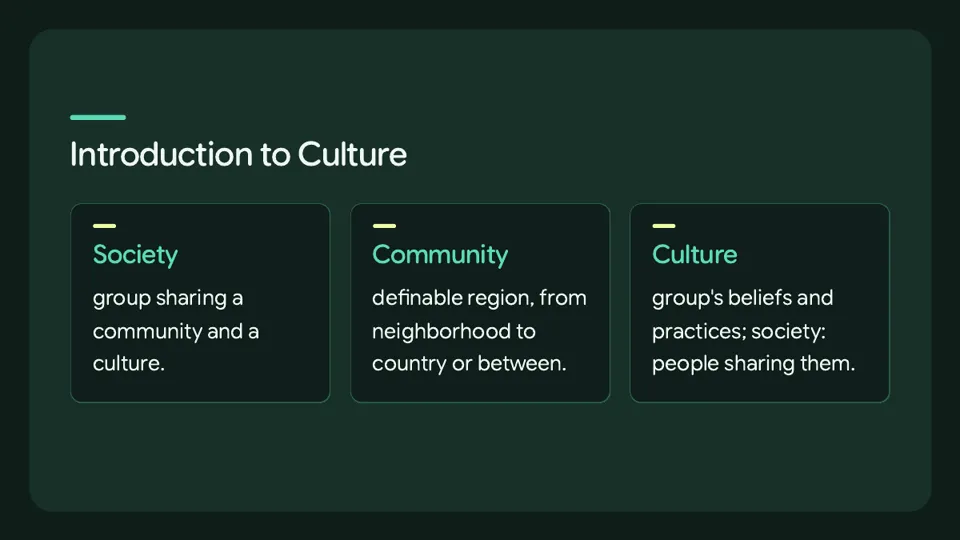
A society describes a group of people who share a community and a culture, and by community sociologists refer to a definable region that can be as small as a neighborhood, as large as a country, or somewhere in between.
A culture represents the beliefs and practices of a group, while society represents the people who share those beliefs and practices.
3.1 What Is Culture?
In modern-day Paris, many people shop daily at outdoor markets to pick up what they need for their evening meal, buying cheese, meat, and vegetables from different specialty stalls, whereas in the United States the majority of people shop once a week at supermarkets, filling large carts to the brim.
In the United States, people tend to view marriage as a choice between two people based on mutual feelings of love, while in other nations and in other times marriages have been arranged through an intricate process of interviews and negotiations between entire families, or in other cases through a direct system such as a mail order bride.
Material culture refers to the objects or belongings of a group of people, while nonmaterial culture consists of the ideas, attitudes, and beliefs of a society.
Material and nonmaterial aspects of culture are linked, and physical objects often symbolize cultural ideas.
A metro pass is a material object, but it represents a form of nonmaterial culture, namely capitalism and the acceptance of paying for transportation.
Clothing, hairstyles, and jewelry are part of material culture, but the appropriateness of wearing certain clothing for specific events reflects nonmaterial culture.
A school building belongs to material culture, but the teaching methods and educational standards are part of education's nonmaterial culture.
But when boarding a bus in Cairo, passengers might have to run, because buses there often do not come to a full stop to take on patrons.
Dublin bus riders would be expected to extend an arm to indicate that they want the bus to stop for them.
And when boarding a commuter train in Mumbai, passengers must squeeze into overstuffed cars amid a lot of pushing and shoving on the crowded platforms.
Cultural Universals
Cultural universals are patterns or traits that are globally common to all societies.
One example of a cultural universal is the family unit: every human society recognizes a family structure that regulates sexual reproduction and the care of children.
In many Asian cultures, family members from all generations commonly live together in one household, and young adults continue to live in the extended household family structure until they marry and join their spouse's household, or they may remain and raise their nuclear family within the extended family's homestead.
In the United States, by contrast, individuals are expected to leave home and live independently for a period before forming a family unit that consists of parents and their offspring.
Other cultural universals include customs like funeral rites, weddings, and celebrations of births, although each culture may view the ceremonies quite differently.
Anthropologist George Murdock first recognized the existence of cultural universals while studying systems of kinship around the world, and through his research Murdock identified other universals including language, the concept of personal names, and jokes.
Murdock found that cultural universals often revolve around basic human survival, such as finding food, clothing, and shelter, or around shared human experiences, such as birth and death or illness and healing.
Humor seems to be a universal way to release tensions and create a sense of unity among people, and sociologists consider humor necessary to human interaction because it helps individuals navigate otherwise tense situations.
Is Music a Cultural Universal?
A team of psychologists led by Thomas Fritz of the Max Planck Institute for Human Cognitive and Brain Sciences in Leipzig, Germany, studied in 2009 how people react to music they have never heard.
The research team travelled to Cameroon, Africa, and asked Mafa tribal members to listen to Western music.
The tribe was isolated from Western culture and had never been exposed to it, so its members had no context or experience within which to interpret Western music.
Even so, when the tribal members listened to a Western piano piece, they could recognise three basic emotions: happiness, sadness and fear.
In fact, scientists who study the evolution of language have concluded that originally language (an established component of group identity) and music were one (Darwin 1871).
Additionally, since music is largely nonverbal, the sounds of music can cross societal boundaries more easily than words.
Music, it turns out, is a sort of universal language. Researchers also found that music can foster a sense of wholeness within a group.
Ethnocentrism and Cultural Relativism — selected points
In some Middle Eastern cultures it is common to stand close to others in conversation, whereas North Americans keep more distance and maintain a large personal space.
Such attitudes exemplify ethnocentrism, which means evaluating and judging another culture by how it compares to one's own cultural norms, and which the sociologist William Graham Sumner described as involving a belief or attitude that one's own culture is better than all others.
Americans, for example, tend to say that people from England drive on the wrong side of the road rather than on the other side, and referring to parts of Asia as the Far East is a good example of ethnocentrism, since one might ask, far east of where.
A traveller from Chicago might find the nightly silence of rural Montana unsettling rather than peaceful, and an exchange student from China might be annoyed by the constant interruptions in class as other students ask questions, a practice considered rude in China.
Barger, originally from Indiana, hesitated when invited to join a local snowshoe race because he knew he would never hold his own against these experts, and he finished last, to his mortification, yet the tribal members congratulated him, saying that he had really tried.
People with the best intentions sometimes travel to a society to “help” its people, because they see them as uneducated or backward—essentially inferior. In reality, these travelers are guilty of cultural imperialism.
A more modern example of cultural imperialism may include the work of international aid agencies who introduce agricultural methods and plant species from developed countries while overlooking indigenous varieties and agricultural approaches that are better suited to the particular region.
In Barger’s own culture, he had learned to value victory. To the Inuit people, winning was enjoyable, but their culture valued survival skills essential to their environment: how hard someone tried could mean the difference between life and death.
Over the course of his stay, Barger participated in caribou hunts, learned how to take shelter in winter storms, and sometimes went days with little or no food to share among tribal members.
Trying hard and working together, two nonmaterial values, were indeed much more important than winning.
Cultural relativism is the practice of assessing a culture by its own standards rather than viewing it through the lens of one’s own culture.
Practicing cultural relativism requires an open mind and a willingness to consider, and even adapt to, new values and norms. However, indiscriminately embracing everything about a new culture is not always possible.
Even the most culturally relativist people from egalitarian societies—ones in which women have political rights and control over their own bodies—would question whether the widespread practice of female genital mutilation in countries such as Ethiopia and Sudan should be accepted as a part of cultural tradition.
Xenocentrism is the opposite of ethnocentrism, and refers to the belief that another culture is superior to one’s own.
An exchange student who goes home after a semester abroad or a sociologist who returns from the field may find it difficult to associate with the values of their own culture after having experienced what they deem a more upright or nobler way of living.
It is impossible for anyone to keep all cultural biases at bay; the best we can do is strive to be aware of them.
Overcoming Culture Shock
During her summer vacation Caitlin flew from Chicago to Madrid to visit Maria, the exchange student she had befriended the previous semester, and Maria's mother kissed Caitlin on both cheeks when she greeted her, while her imposing father kept his distance, and Caitlin was half asleep by the time supper was served at ten in the evening.
Maria's family sat at the table for hours, speaking loudly, gesturing and arguing about politics, a taboo dinner subject in Caitlin's house, and they served wine and toasted their honoured guest.
Caitlin had not realised that people depend not only on spoken words but also on subtle cues such as gestures and facial expressions to communicate, and cultural norms accompany even the smallest nonverbal signals, helping people know when to shake hands, where to sit, how to converse and even when to laugh.
Recovering from culture shock can take weeks or months, and fully adjusting to living in a new culture can take years.
Values and Beliefs
Values are a culture's standard for discerning what is good and just in society, and values are deeply embedded and critical for transmitting and teaching a culture's beliefs.
Beliefs are the tenets or convictions that people hold to be true, and individuals in a society have specific beliefs but also share collective values.
To illustrate the difference, Americans commonly believe in the American Dream, that anyone who works hard enough will be successful and wealthy, and underlying this belief is the American value that wealth is good and important.
Quiz (7 questions)
Which term matches this description: “shared beliefs, values, and practices, that participants must learn”?
- Culture
- Ethnocentrism
- Cultural universals
- Beliefs
Show the answer
Culture. Culture is the shared beliefs, values, and practices that participants must learn. Cultural universals are patterns or traits globally common to all societies, not the definition given. Ethnocentrism is evaluating and judging another culture by comparison with one's own norms. Beliefs are tenets or convictions people hold to be true, only one part of the description.
Which term matches this description: “a group of people who share a community and a culture”?
- Cultural universals
- Society
- Xenocentrism
- Values
Show the answer
Society. A society is a group of people who share a community and a culture. Cultural universals are patterns or traits globally common to all societies, not a group of people. Xenocentrism is the belief that another culture is superior to one's own, not a group sharing a community. Values are the standards a group holds, not the people themselves.
“patterns or traits that are globally common to all societies” — which term does this describe?
- Culture
- Society
- Cultural universals
- Cultural relativism
Show the answer
Cultural universals. Cultural universals are patterns or traits that are globally common to all societies. Culture is the shared beliefs, values, and practices that participants must learn, not patterns common to all societies. Society is a group of people who share a community and a culture, not a pattern or trait. Cultural relativism is evaluating a culture by its own standards, not a globally common pattern.
True or false: Sociologists consider humor necessary to human interaction because it helps individuals navigate otherwise tense situations.
- True
- False
Show the answer
True. Sociologists consider humor necessary to human interaction because it helps individuals navigate otherwise tense situations, and humor is a cultural universal that releases tensions and creates unity. The statement is therefore true rather than false.
How do culture and society differ?
- Culture is the people who share a community, while society is the beliefs and practices they hold.
- Culture is the material objects of a group, while society is its nonmaterial ideas.
- Culture is a definable region, while society is the community that lives within it.
- Culture is the beliefs and practices of a group, while society is the people who share them.
Show the answer
Culture is the beliefs and practices of a group, while society is the people who share them.. Culture represents the beliefs and practices of a group, while society represents the people who share those beliefs and practices. Material objects versus nonmaterial ideas is the distinction between material and nonmaterial culture, not between culture and society. A definable region is how sociologists describe a community, not the difference between the two terms. Reversing the two terms is incorrect, since culture is not the people and society is not the beliefs and practices.
Imagine a student from a small town moves to a large city and is initially excited by the fast pace, but after a few weeks feels stressed and unsure how to behave in everyday situations, then gradually settles in as the routines become familiar. What does this sequence illustrate?
- Cultural imperialism
- Ethnocentrism
- Xenocentrism
- Recovering from culture shock
Show the answer
Recovering from culture shock. People usually find a new culture exciting at first, then become stressed, and eventually recover as they learn more about it, which is recovering from culture shock. Cultural imperialism is the deliberate imposition of one's own cultural values on another culture, not this sequence. Ethnocentrism is judging another culture by one's own norms, not the process of settling in. Xenocentrism is the belief that another culture is superior to one's own, not recovery from disorientation.
Which statement defines “ethnocentrism”?
- evaluating and judging another culture based on how it compares to one's own cultural norms
- the objects or belongings of a group of people
- The tenets or convictions that people hold to be true.
- a group of people who share a community and a culture
Show the answer
evaluating and judging another culture based on how it compares to one's own cultural norms. Ethnocentrism is evaluating and judging another culture based on how it compares to one's own cultural norms. The objects or belongings of a group of people describe material culture, not ethnocentrism. The tenets or convictions that people hold to be true describe beliefs. A group of people who share a community and a culture describes a society.