YUHINA
  • Home
  • Process
  • Outputs
  • Pricing
English▾
  • English
  • العربية
  • Français
  • Español
  • Deutsch
  • Português
  • Italiano
  • हिन्दी
  • 中文
  • 日本語
  • 한국어
  • Türkçe
  • Русский
  • Bahasa Indonesia
Sign in

How can we help?

Pick what it's about. The answer may already be below.

Something in the app isn't working the way it should.

My verification code hasn't arrived.+

YUHINA sends a 6-digit code to the address you signed up with. Check your spam or promotions folder. If it still isn't there after a few minutes, email support from that address.

Why can't I generate anything?+

You need a verified email first. A new account includes one free chapter with every output, once. After that, generating spends your plan's monthly usage or pay-as-you-go credit, so you need a plan or some credit to keep going.

My PDF gave weak results.+

Each PDF is one chapter, up to 60 pages. A digital PDF with text you can select gives the clearest lessons; blurry, dark, skewed or handwritten scans give weaker ones.

How do I delete my account or my files?+

The app's privacy notice explains how to export or permanently delete your account and everything in it. If something doesn't work, email support.

Still stuck? Email support, from the address on your account:

support@yuhina.ai

Buying for a school or a company? Talk to our enterprise team: enterprise@yuhina.ai

Sample library · American Government

The Constitution and Its Origins: video lessons, quiz and flashcards from one textbook chapter

What YUHINA made from one american government chapter: 3 narrated video lessons with slides, 104 questions, 15 flashcards, a mind map and a podcast.

  • 3 lessons
  • 82 slides
  • 104 questions
  • 15 flashcards
  • 55-minute podcast

Generated by YUHINA on 2026-11-10 from a 15-page PDF and shown unedited.

Source: sections 2.1 to 2.3 of chapter 2, “The Constitution and Its Origins”, from American Government (3rd edition) by Glen Krutz, Sylvie Waskiewicz et al., OpenStax, licensed CC BY 4.0. American Government. Access the book for free at openstax.org. Changes: YUHINA turned the text into lessons, slides, narration, questions, flashcards, a mind map and a podcast.

Try it with your own chapterSee pricing

The narrated video

The first 60 seconds of lesson 1. The chapter came out as 3 video lessons, about 56 minutes in all.

The first slides of lesson 1

  • Slide 1 of lesson 1
  • Slide 2 of lesson 1
  • Slide 3 of lesson 1

The lessons

YUHINA split the chapter into lessons. Each one has its own summary and quiz, shown below as generated.

Lesson 1: Origins of American Political Thought and the Roots of Revolution

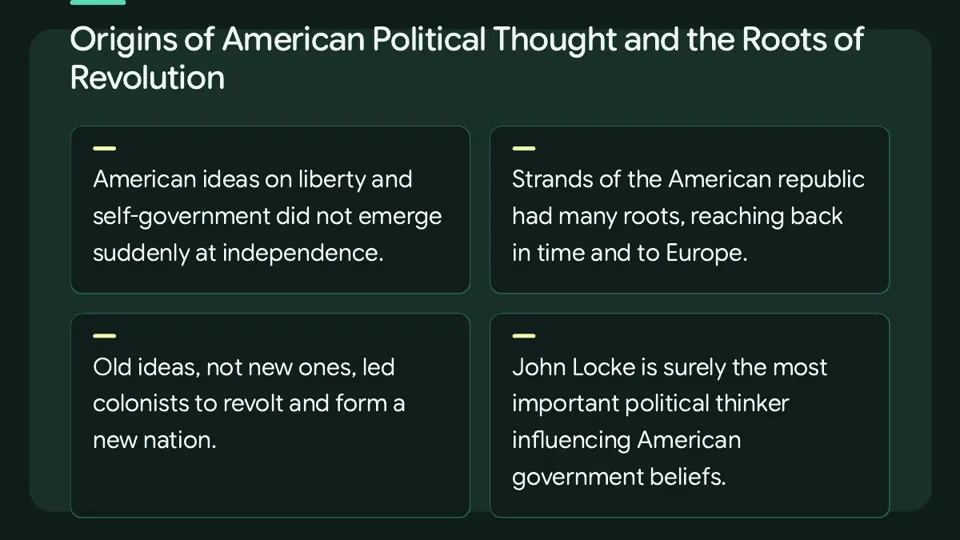
American political ideas about liberty and self-government did not appear fully formed at the moment the colonists declared independence from Britain.

The varied strands that became the American republic had many roots reaching far back in time and across the Atlantic to Europe, and it was old ideas rather than new ones that led the colonists to revolt and form a new nation.

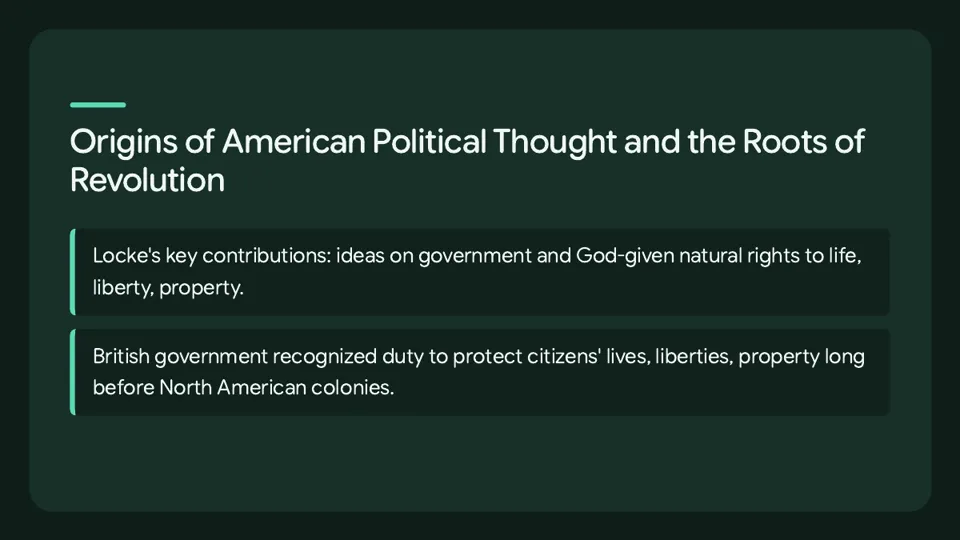
John Locke, a seventeenth-century English philosopher, is surely the most important of the political thinkers who influenced American beliefs about government, and his most significant contributions concerned the relationship between government and natural rights, believed to be God-given rights to life, liberty, and property.

The British government had recognized its duty to protect the lives, liberties, and property of English citizens long before its North American colonies were settled, and protections for life, liberty, and property are prominent among Magna Carta's many provisions.

The rights protected by Magna Carta had been granted by the king, and, in theory, a future king or queen could take them away; the English Bill of Rights, heavily influenced by Locke's ideas, enumerated the rights of English citizens and explicitly guaranteed rights to life, liberty, and property.

In the colonists' eyes, all free White males should have the right to acquire property, and once property had been acquired, government had the duty to protect it.

Most Europeans of the time believed monarchy had been created by God and that kings and queens were divinely appointed to rule, but Locke theorized that human beings, not God, had created government.

The belief that government should not deprive people of their liberties and should be restricted in its power over citizens' lives was an important factor in the controversial decision by the American colonies to declare independence from England in 1776.

Americans were accustomed to the idea of representative government from the beginning, and the American Revolution began when American colonists felt that this longstanding tradition of representative self-government was threatened by the actions of Parliament and the King.

The American Revolution began when a small and vocal group of colonists became convinced that the king and Parliament were abusing them and depriving them of their rights.

Among the acts passed by Parliament were laws requiring colonists to pay British merchants with gold and silver instead of paper currency and a mandate that suspected smugglers be tried in vice-admiralty courts without jury trials.

Because the colonists had not consented to direct taxation, their primary objection was that it reduced their status as free men, and the right of the people or their representatives to consent to taxation was enshrined in both Magna Carta and the English Bill of Rights.

Taxes were imposed by the House of Commons, one of the two houses of the British Parliament, but the North American colonists were not allowed to elect representatives to that body, and many colonists maintained that anything except direct representation violated their rights as English subjects.

Following this event, later known as the Boston Massacre, resistance to British rule grew, especially in Massachusetts.

In the 2010s, many who did not agree with the positions of the Democratic or Republican Party organized themselves into an oppositional group dubbed the Tea Party.

In May 1775 delegates met again in the Second Continental Congress, by which time war with Great Britain had already begun following skirmishes between colonial militiamen and British troops at Lexington and Concord, Massachusetts, and Congress drafted a Declaration of Causes explaining the colonies' reasons for rebellion.

On July 2, 1776, Congress declared American independence from Britain and two days later signed the Declaration of Independence, which was drafted by Thomas Jefferson and officially proclaimed the colonies' separation from Britain.

Jefferson charged that the king had taxed the colonists without the consent of their elected representatives, interfered with their trade, denied them the right to trial by jury, and deprived them of their right to self-government.

People sacrificed a small portion of their freedom and consented to be ruled in exchange for the government’s protection of their lives, liberty, and property. Locke called this implicit agreement between a people and their government the social contract.

Should government deprive people of their rights by abusing the power given to it, the contract was broken and the people were no longer bound by its terms.

The people could thus withdraw their consent to obey and form another government for their protection.

For Locke, withdrawing consent to be ruled by an established government and forming a new one meant replacing one monarch with another.

For those colonists intent on rebelling, however, it meant establishing a new nation and creating a new government, one that would be greatly limited in the power it could exercise over the people. The desire to limit the power of government is closely related to the belief that people should govern themselves.

By 1776, they had been living under the rule of the British government for more than a century, and England had long treated the thirteen colonies with a degree of benign neglect.

Taxes imposed by England were low, and property ownership was more widespread than in England.

For the most part, American colonists were proud to be British citizens and had no desire to form an independent nation.

The outcry was so great that the new tax was quickly withdrawn, but its repeal was soon followed by a series of other tax acts, such as the Townshend Acts (1767), which imposed taxes on many everyday objects such as glass, tea, and paint.

The Massachusetts legislature sent a petition to the king asking for relief from the taxes and requested that other colonies join in a boycott of British manufactured goods.

British officials threatened to suspend the legislatures of colonies that engaged in a boycott and, in response to a request for help from Boston’s customs collector, sent a warship to the city in 1768.

In December 1773, a group of Boston men boarded a ship in Boston harbor and threw its cargo of tea, owned by the British East India Company, into the water to protest British policies, including the granting of a monopoly on tea to the British East India Company, which many colonial merchants resented.3 This act of defiance became known as the Boston Tea Party.

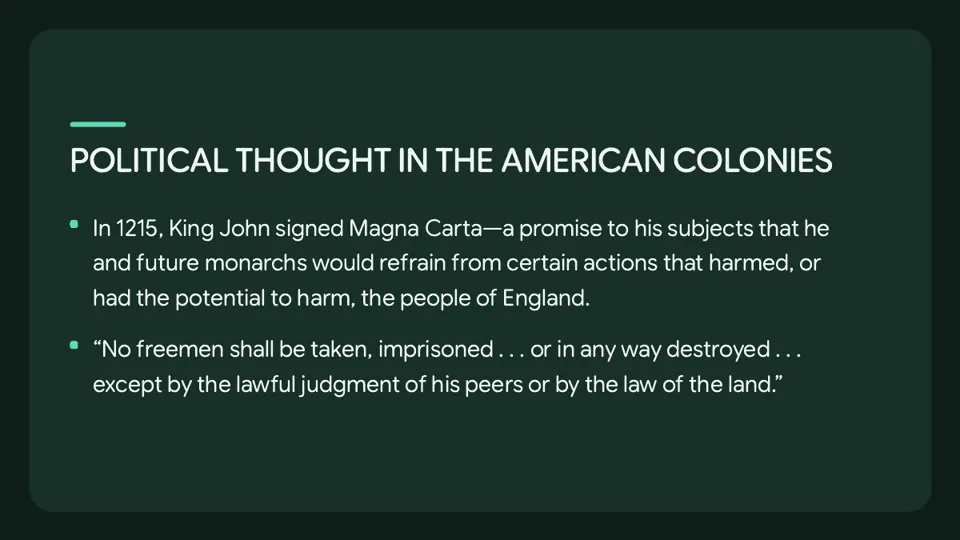
POLITICAL THOUGHT IN THE AMERICAN COLONIES — selected points

Magna Carta was a promise by King John and future monarchs to refrain from certain actions that harmed, or had the potential to harm, the people of England.

The rights protected by Magna Carta had been granted by the king and could in theory be taken away by a future king or queen, whereas the natural rights Locke described had been granted by God and thus could never be abolished by human beings, even royal ones, or by the institutions they created.

Before offering the throne to William and Mary, Parliament passed the English Bill of Rights in 1689, and a bill of rights is a list of the liberties and protections possessed by a nation’s citizens.

The English Bill of Rights, heavily influenced by Locke’s ideas, enumerated the rights of English citizens and explicitly guaranteed rights to life, liberty, and property, and this document would profoundly influence the U.S. Constitution and Bill of Rights.

The British government did allow for a degree of self-government: laws were made by Parliament, and property-owning males were allowed to vote for representatives to Parliament.

For instance, Virginia established its House of Burgesses in 1619, and by the eighteenth century all the colonies had established legislatures to which men were elected to make the laws for their fellow colonists.

According to Locke, anyone who invested labor in the commons—the land, forests, water, animals, and other parts of nature that were free for the taking—might take as much of these as needed, by cutting trees, for example, or building a fence around a field.

The only restriction was that no one could take so much that others were deprived of their right to take from the commons as well.

THE AMERICAN REVOLUTION — selected points

All this began to change in 1763 when the Seven Years War between Great Britain and France came to an end and Great Britain gained control of most of the French territory in North America.

The colonists had fought on behalf of Britain, and many colonists expected that after the war they would be allowed to settle on land west of the Appalachian Mountains that had been taken from France, but their hopes were not realized.

Hoping to prevent conflict with Indian tribes in the Ohio Valley, Parliament passed the Proclamation of 1763, which forbade the colonists to purchase land or settle west of the Appalachian Mountains.

To pay its debts from the war and maintain the troops it left behind to protect the colonies, the British government had to take new measures to raise revenue.

What angered the colonists most of all, however, was the imposition of direct taxes: taxes imposed on individuals instead of on transactions.

A few months later, British troops arrived, and on the evening of March 5, 1770, an altercation erupted outside the customs house; shots rang out as the soldiers fired into the crowd, several people were hit, and three died immediately.

The king had “establish[ed] . . . an absolute Tyranny over these States.”

Just as their English forebears had removed King James II from the throne in 1689, the colonists now wished to establish a new rule.

Jefferson then proceeded to list the many ways in which the British monarch had abused his power and failed in his duties to his subjects, and such intrusions on their rights could not be tolerated; with their signing of the Declaration of Independence, the founders of the United States committed themselves to the creation of a new kind of government.

In the early months of 1774, Parliament responded to this latest act of colonial defiance by passing a series of laws called the Coercive Acts, intended to punish Boston for leading resistance to British rule and to restore order in the colonies.

These acts virtually abolished town meetings in Massachusetts and otherwise interfered with the colony’s ability to govern itself.

This assault on Massachusetts and its economy enraged people throughout the colonies, and delegates from all the colonies except Georgia formed the First Continental Congress to create a unified opposition to Great Britain. Among other things, members of the institution developed a declaration of rights and grievances.

Quiz (8 questions)

  1. Which term matches this description: “a promise by King John to his subjects that he and future monarchs would refrain from certain actions that harmed, or had the potential to harm, the people of England”?

    • Magna Carta
    • Bill of rights
    • Mayflower Compact
    • Proclamation of 1763
    Show the answer

    Magna Carta. Magna Carta was the promise King John signed in 1215 that he and future monarchs would refrain from certain actions that harmed, or could harm, the people of England. A bill of rights is a list of the liberties and protections possessed by a nation's citizens. The Mayflower Compact was an agreement by the Pilgrims to govern themselves by laws made by the colony's male voters. The Proclamation of 1763 forbade colonists to purchase land or settle west of the Appalachian Mountains.

  2. Which term is defined as “a list of the liberties and protections possessed by a nation's citizens”?

    • Boston tea Party
    • Bill of rights
    • Proclamation of 1763
    • Magna Carta
    Show the answer

    Bill of rights. A bill of rights is a list of the liberties and protections possessed by a nation's citizens, and the English Bill of Rights enumerated such rights and guaranteed life, liberty, and property. The Boston Tea Party was a protest in which colonists threw tea into Boston harbor. Magna Carta was King John's promise to refrain from certain harmful actions against the people of England. The Proclamation of 1763 forbade colonists to purchase land or settle west of the Appalachian Mountains.

  3. Which term matches this description: “an agreement to govern themselves according to the laws created by the male voters of the colony”?

    • Commons
    • Proclamation of 1763
    • Mayflower Compact
    • Social contract
    Show the answer

    Mayflower Compact. The Mayflower Compact was the Pilgrims' agreement to govern themselves according to laws created by the male voters of the colony. The commons are the land, forests, water, animals, and other parts of nature free for the taking. The Proclamation of 1763 forbade colonists to purchase land or settle west of the Appalachian Mountains. The social contract is Locke's idea of an implicit agreement between a people and their government.

  4. True or false: The American Revolution began when colonists felt their tradition of representative self-government was threatened by Parliament and the King.

    • True
    • False
    Show the answer

    True. The American Revolution began when colonists felt their longstanding tradition of representative self-government was threatened by the actions of Parliament and the King. That tradition included elected colonial legislatures and, earlier, the Mayflower Compact, under which the Pilgrims governed themselves by laws made by the colony's male voters.

  5. True or false: Magna Carta's provisions prominently include protections for life, liberty, and property.

    • True
    • False
    Show the answer

    True. Magna Carta, the promise King John signed in 1215, prominently includes protections for life, liberty, and property among its many provisions. One of its clauses lays the foundation for the Fifth and Sixth Amendments, and by the American Revolution English subjects regarded it as a cornerstone of liberty for men of all stations.

  6. True or false: The British government recognized its duty to protect the lives, liberties, and property of English citizens long before the settling of its North American colonies.

    • True
    • False
    Show the answer

    True. The British government had recognized its duty to protect the lives, liberties, and property of English citizens long before its North American colonies were settled. Magna Carta, signed by King John in 1215, is an early expression of that duty, and its protections for life, liberty, and property are prominent among its provisions.

  7. Which statement defines “commons”?

    • a tax requiring that almost all paper goods, such as diplomas, land deeds, contracts, and newspapers, have revenue stamps placed on them
    • a promise by King John to his subjects that he and future monarchs would refrain from certain actions that harmed, or had the potential to harm, the people of England
    • the land, forests, water, animals, and other parts of nature that were free for the taking
    • a list of the liberties and protections possessed by a nation's citizens
    Show the answer

    the land, forests, water, animals, and other parts of nature that were free for the taking. The commons are the land, forests, water, animals, and other parts of nature that were free for the taking, and labor invested in them justified taking what was needed, limited only by others' right to take as well. The description of paper goods needing revenue stamps defines the Stamp Act. The promise by King John to refrain from certain harmful actions defines Magna Carta. A list of the liberties and protections possessed by a nation's citizens defines a bill of rights.

  8. Which statement defines “social contract”?

    • a measure that forbade the colonists to purchase land or settle west of the Appalachian Mountains
    • the land, forests, water, animals, and other parts of nature that were free for the taking
    • the implicit agreement between a people and their government
    • an agreement to govern themselves according to the laws created by the male voters of the colony
    Show the answer

    the implicit agreement between a people and their government. The social contract is the implicit agreement between a people and their government, in which people consent to be ruled in exchange for protection of their lives, liberty, and property. The measure forbidding colonists to purchase land or settle west of the Appalachian Mountains is the Proclamation of 1763. The land, forests, water, animals, and other parts of nature free for the taking are the commons. The agreement to govern by laws created by the colony's male voters is the Mayflower Compact.

Lesson 2: Creating a Government Under the Articles of Confederation

Waging a successful war against Great Britain required the individual colonies, now sovereign states that often distrusted one another, to form a unified nation with a central government capable of directing the country's defense.

Gaining recognition and aid from foreign nations would also be easier if the new United States had a national government able to borrow money and negotiate treaties.

The final draft of the Articles of Confederation, which formed the basis of the new nation's government, was accepted by Congress in November 1777 and submitted to the states for ratification.

Maryland argued that all territory west of the Appalachians, to which some states had laid claim, should instead be held by the national government as public land for the benefit of all the states.

When the last of these states, Virginia, relinquished its land claims in early 1781, Maryland approved the Articles, and a few months later the British surrendered.

A confederation is an entity in which independent, self-governing states form a union for the purpose of acting together in areas such as defense.

The central government had authority to act in only a few areas, such as national defense, in which the states were assumed to have a common interest (and would, indeed, have to supply militias).

The Confederation Congress, formerly the Continental Congress, had the authority to exchange ambassadors and make treaties with foreign governments and Indian tribes, declare war, coin currency and borrow money, and settle disputes between states.

Each state legislature appointed delegates to the Congress; these men could be recalled at any time, and regardless of its size or the number of delegates it chose to send, each state would have only one vote.

Delegates could serve for no more than three consecutive years, lest a class of elite professional politicians develop, and the nation would have no independent chief executive or judiciary.

Nine votes were required before the central government could act, and the Articles of Confederation could be changed only by unanimous approval of all thirteen states.

The fiscal problems of the central government meant that the currency it issued, called the Continental, was largely worthless and people were reluctant to use it.

The national government also lacked the power to raise an army or navy, because fears of a standing army in the employ of a tyrannical government had led the writers of the Articles of Confederation to leave defense largely to the states.

republic: a regime in which the people, not a monarch, held power and elected representatives to govern according to the rule of law

Many, however, feared that a nation as large as the United States could not be ruled effectively as a republic. Many also worried that even a government of representatives elected by the people might become too powerful and overbearing.

Following the Declaration of Independence, each of the thirteen states had drafted and ratified a constitution providing for a republican form of government in which political power rested in the hands of the people, although the right to vote was limited to free (White) men, and the property requirements for voting differed among the states.

Each state had a governor and an elected legislature.

One of the biggest problems was that the national government had no power to impose taxes.

To avoid any perception of “taxation without representation,” the Articles of Confederation allowed only state governments to levy taxes.

To pay for its expenses, the national government had to request money from the states, which were required to provide funds in proportion to the value of the land within their borders.

2.2 The Articles of Confederation

Accordingly, the Second Continental Congress called upon its delegates to create a new government strong enough to win the country's independence but not so powerful that it would deprive people of the very liberties for which they were fighting.

PUTTING A NEW GOVERNMENT IN PLACE

The Articles of Confederation would not become the law of the land until all thirteen states had approved it, and within two years, all except Maryland had done so.

Fearful of replacing one oppressive national government with another, however, the framers of the Articles of Confederation created an alliance of sovereign states held together by a weak central government.

WHAT WENT WRONG WITH THE ARTICLES? — selected points

The states, however, were often negligent in this duty, and the national government was underfunded.

Without money, it could not pay debts owed from the Revolution and had trouble conducting foreign affairs.

For example, the inability of the U.S. government to raise sufficient funds to compensate colonists who had remained loyal to Great Britain for their property losses during and after the American Revolution was one of the reasons the British refused to evacuate the land west of the Appalachians.

The new nation was also unable to protect American ships from attacks by the Barbary pirates.

Foreign governments were also, understandably, reluctant to loan money to a nation that might never repay it because it lacked the ability to tax its citizens.

Furthermore, while the Articles of Confederation had given the national government the power to coin money, they had not prohibited the states from doing so as well; as a result, numerous state banks issued their own banknotes, which had the same problems as the Continental.

The country's economic woes were made worse by the fact that the central government also lacked the power to impose tariffs on foreign imports or regulate interstate commerce, and thus it was unable to prevent British merchants from flooding the U.S. market with low-priced goods after the Revolution, and American producers suffered from the competition.

Compounding the problem, states often imposed tariffs on items produced by other states and otherwise interfered with their neighbors' trade.

Although the central government could declare war and agree to peace, it had to depend upon the states to provide soldiers, and if state governors chose not to honor the national government's request, the country would lack an adequate defense.

Problems with the Articles of Confederation

The national government lacked the power to impose taxes on citizens and could only request money from the states, but requests for money were usually not honored, leaving the national government without funds to pay for national defense or fulfill its other responsibilities.

The national government could not regulate foreign trade or interstate commerce, and it could not prevent foreign countries from hurting American competitors by shipping inexpensive products to the United States or prevent states from passing laws that interfered with domestic trade.

The national government could not raise an army and had to request the states to send men, but state governments could choose not to honor Congress's request for troops, which would make it hard to defend the nation.

Problems with the Articles of Confederation — selected points

Each state had only one vote in Congress regardless of its size, so populous states were less well represented.

The Articles could not be changed without a unanimous vote, so problems with the Articles could not be easily fixed, and there was no national judicial system, although judiciaries are important enforcers of national government power.

The Articles of Confederation suffered from many problems that could not be easily repaired, and the biggest problem was the lack of power given to the national government.

Shays’ Rebellion: Symbol of Disorder and Impetus to Act

In the summer of 1786, farmers in western Massachusetts were heavily in debt, facing imprisonment and the loss of their lands, because they owed taxes that had gone unpaid while they were away fighting the British during the Revolution.

The Continental Congress had promised to pay the farmers for their service, but the national government did not have sufficient money, and the farmers were unable to meet the onerous new tax burden Massachusetts imposed in order to pay its own debts from the Revolution.

Led by Daniel Shays, the heavily indebted farmers marched to a local courthouse demanding relief.

Faced with the refusal of many Massachusetts militiamen to arrest the rebels, with whom they sympathized, Governor James Bowdoin called upon the national government for aid, but none was available.

The uprising was finally brought to an end the following year by a privately funded militia after the protestors' unsuccessful attempt to raid the Springfield Armory.

2.3 The Development of the Constitution

In 1786, Virginia and Maryland invited delegates from the other eleven states to meet in Annapolis, Maryland, for the purpose of revising the Articles of Confederation, but only five states sent representatives.

Because all thirteen states had to agree to any alteration of the Articles, the convention in Annapolis could not accomplish its goal.

Two of the delegates, Alexander Hamilton and James Madison, requested that all states send delegates to a convention in Philadelphia the following year to attempt once again to revise the Articles of Confederation.

All the states except Rhode Island chose delegates to send to the meeting, a total of seventy men in all, but many did not attend, and among those not in attendance were John Adams and Thomas Jefferson, both of whom were overseas representing the country as diplomats.

Because the shortcomings of the Articles of Confederation proved impossible to overcome, the convention that met in Philadelphia in 1787 decided to create an entirely new government.

POINTS OF CONTENTION

Fifty-five delegates arrived in Philadelphia in May 1787 for the meeting that became known as the Constitutional Convention.

Many wanted to strengthen the role and authority of the national government but feared creating a central government that was too powerful, and they wished to preserve state autonomy, although not to a degree that prevented the states from working together collectively or made them entirely independent of the will of the national government.

Quiz (4 questions)

  1. Which term matches this description: “a regime in which the people, not a monarch, held power and elected representatives to govern according to the rule of law”?

    • Mayflower Compact
    • Confederation
    • Coercive acts
    • Republic
    Show the answer

    Republic. A republic is a regime in which the people, not a monarch, hold power and elect representatives to govern according to the rule of law. The Mayflower Compact was an agreement among early settlers, not a general form of government. The Coercive Acts were punitive British laws, not a regime. A confederation is a union of sovereign states, not the definition given.

  2. True or false: Because all thirteen states had to agree to any alteration of the Articles, the Annapolis convention could not accomplish its goal.

    • True
    • False
    Show the answer

    True. Changing the Articles required the agreement of all thirteen states, so the Annapolis convention, with only five states represented, could not accomplish its goal. The statement is therefore true, not false.

  3. True or false: The Confederation Congress had authority to exchange ambassadors, make treaties with foreign governments and Indian tribes, declare war, coin currency, borrow money, and settle disputes between states.

    • True
    • False
    Show the answer

    True. The Confederation Congress had authority to exchange ambassadors, make treaties with foreign governments and Indian tribes, declare war, coin currency, borrow money, and settle disputes between states. The statement is therefore true, not false.

  4. True or false: Because the shortcomings of the Articles of Confederation proved impossible to overcome, the convention in Philadelphia in 1787 decided to create an entirely new government.

    • True
    • False
    Show the answer

    True. The shortcomings of the Articles of Confederation proved impossible to overcome, so the Philadelphia convention of 1787 decided to create an entirely new government rather than revise the Articles. The statement is therefore true, not false.

Lesson 3: Conflicts and Debates at the Constitutional Convention

The number of a state's representatives in each house was to be based on the state's population, and representatives in the lower house would be elected by popular vote in each state.

A representative could not be reelected until an unspecified amount of time had passed after the representative's term in the legislature had ended.

The New Jersey Plan was a proposal calling for a unicameral legislature with one house in which each state would have one vote, so that smaller states would have the same power in the national legislature as larger states.

In addition to supporting the agriculture of the South, enslaved people could be taxed as property and counted as population for purposes of a state's representation in the government.

Supporters of a strong central government argued that it was necessary for the survival and efficient functioning of the new nation, since without the authority to maintain and command an army and navy the nation could not defend itself at a time when European powers still maintained formidable empires in North America.

Without the power to tax and regulate trade, the government would not have enough money to maintain the nation's defense, protect American farmers and manufacturers from foreign competition, create the infrastructure necessary for interstate commerce and communications, maintain foreign embassies, or pay federal judges and other government officials.

Such delegates approved the approach of the New Jersey Plan, which retained the unicameral Congress that had existed under the Articles of Confederation, under which Congress could not impose taxes without the consent of the states.

Others believed it was more important for the national government to maintain order, and this might require it to limit personal liberty at times, while all Americans desired that the government not intrude upon people's rights to life, liberty, and property without reason.

Each state, regardless of size, would have two senators, making for equal representation as in the New Jersey Plan, while representation in the House would be based on population.

Senators were to be appointed by state legislatures, a variation on the Virginia Plan, and members of the House of Representatives would be popularly elected by the voters in each state.

Elected members of the House would be limited to two years in office before having to seek reelection, and those appointed to the Senate by each state's political elite would serve a term of six years.

Congress was given great power, including the power to tax, maintain an army and a navy, and regulate trade and commerce.

To mollify the north, the compromise also allowed counting 60 percent of a state's enslaved population for federal taxation, although no such taxes were ever collected.

Because the southern states, especially South Carolina, had made it clear they would leave the convention if abolition were attempted, no serious effort was made by the framers to abolish slavery in the new nation, even though many delegates disapproved of the institution.

Article I postponed the abolition of the foreign slave trade until 1808, and in the interim, those in slaveholding states were allowed to import as many enslaved people as they wished; furthermore, the Constitution placed no restrictions on the domestic slave trade, so residents of one state could still sell enslaved people to other states.

Others, however, feared that a strong national government might become too powerful and use its authority to oppress citizens and deprive them of their rights.

Article IV of the Constitution—which, among other things, required states to return freedom seekers to the states where they had been charged with crimes—also prevented the enslaved from gaining their freedom by escaping to states where slavery had been abolished.

Clause 3 of Article IV (known as the fugitive slave clause) allowed enslavers to reclaim the enslaved in the states where they had fled.9

2.3 • The Development of the Constitution

The delegates wished to give political rights to all free men but also feared mob rule, which many felt would have been the result of Shays' Rebellion had it succeeded.

The only decision that all could agree on was the election of George Washington, the former commander of the Continental Army and hero of the American Revolution, as the president of the convention.

The Question of Representation: Small States vs. Large States

However, the larger states argued that because they had more residents, they should be allotted more legislators to represent their interests.

These representatives would then select their state’s representatives in the upper house from among candidates proposed by the state’s legislature.

Slavery and Freedom

Pennsylvania, for example, had passed the Act for the Gradual Abolition of Slavery in 1780, under which all people born in the state to enslaved mothers after the law's passage would become indentured servants to be set free at age twenty-eight.

In 1783, Massachusetts had freed all enslaved people within the state.

Many Americans believed slavery was opposed to the ideals stated in the Declaration of Independence, while others felt it was inconsistent with the teachings of Christianity.

Some White people feared for their safety if the enslaved population or Americans' reliance on slavery were to increase.

Although some southerners shared similar sentiments, none of the southern states had abolished slavery and none wanted the Constitution to interfere with the institution.

Federal Supremacy vs. State Sovereignty

Delegates who wanted a strong national government argued that it should be able to legislate for the states in many areas and even to veto laws passed by state legislatures, and the Virginia Plan also gave more power to populous states.

Others advocated a central government with sufficient authority to defend the nation while insisting that other powers be left to the states, which were believed to understand and protect the needs and interests of their residents better.

The New Jersey Plan gave additional power to the national government, such as the power to regulate interstate and foreign commerce and to compel states to comply with laws passed by Congress.

Other countries would be reluctant to loan money to the United States if the federal government lacked the ability to impose taxes in order to repay its debts.

Furthermore, the nation’s chief executive, appointed by the Congress, could be removed by Congress if state governors demanded it.

Individual Liberty vs. Social Stability

The belief that the king and Parliament had deprived colonists of their liberties had led to the Revolution, and many feared that the government of the United States might one day attempt to do the same.

People wanted and expected their new government to guarantee the rights of life, liberty, and property.

The Great Compromise — selected points

Legislation could be proposed by either chamber of Congress, but it had to pass both chambers by a majority vote before being sent to the president to be signed into law, and all bills to raise revenue had to begin in the House of Representatives.

Only men elected by the voters to represent them could impose taxes upon them, so there would be no more taxation without representation.

The Three-Fifths Compromise and the Debates over Slavery — selected points

If enslaved people were not counted, southern states would have far fewer representatives in the House than northern states did; for example, if South Carolina were allotted representatives based solely on its free population, it would receive only half the number it would have received if enslaved people, who made up approximately 43 percent of the population, were included.

For purposes of Congressional apportionment, slaveholding states were allowed to count all their free population, including free African Americans, and 60 percent (three-fifths) of their enslaved population.

Separation of Powers and Checks and Balances — selected points

A system of checks and balances gave each of three branches of government the power to restrict the actions of the others, thus requiring them to work together.

Federal Power vs. State Power — selected points

All powers not expressly given to the national government were intended to be exercised by the states, and these powers are known as reserved powers.

States remained free to pass laws regarding such things as intrastate commerce, meaning commerce within the borders of a state, and marriage.

Some powers, such as the right to levy taxes, were given to both the state and federal governments.

Both the states and the federal government have a chief executive to enforce the laws, a governor and the president respectively, and a system of courts.

Quiz (6 questions)

  1. Which term is defined as “a proposal calling for a unicameral legislature with one house in which each state would have one vote”?

    • Separation of powers
    • Great compromise
    • Fugitive slave clause
    • New Jersey Plan
    Show the answer

    New Jersey Plan. The New Jersey Plan called for a unicameral legislature with one house in which each state would have one vote, giving smaller states the same power as larger states. Separation of powers divides the national government into three branches with different responsibilities, not a one-house legislature. The Great compromise created a two-chamber Congress with equal state representation in the Senate and population-based representation in the House. The fugitive slave clause allowed enslavers to reclaim the enslaved in states where they had fled, not a plan for Congress.

  2. “a system giving each of the three branches of government the power to restrict the actions of the others, requiring them to work together” — which term does this describe?

    • Checks and balances
    • Separation of powers
    • Fugitive slave clause
    • Three-Fifths compromise
    Show the answer

    Checks and balances. Checks and balances gives each of the three branches the power to restrict the actions of the others, requiring them to work together. Separation of powers divides the government into three branches with different responsibilities, but does not itself describe the power of each to restrict the others. The fugitive slave clause allowed enslavers to reclaim the enslaved in states where they had fled, not a system among branches. The Three-Fifths compromise concerned counting enslaved people for representation, not the branches of government.

  3. Which term is defined as “A system giving each of the three branches of government the power to restrict the actions of the others, thus requiring them to work together.”?

    • Great compromise
    • Checks and balances
    • New Jersey Plan
    • Three-Fifths compromise
    Show the answer

    Checks and balances. Checks and balances is the system giving each of the three branches the power to restrict the actions of the others, requiring them to work together. The Great compromise created a two-chamber Congress with equal state representation in the Senate and population-based representation in the House. The New Jersey Plan called for a one-house legislature in which each state would have one vote. The Three-Fifths compromise concerned counting enslaved people for representation, not the branches of government.

  4. True or false: Article IV required states to return freedom seekers to the states where they had been charged with crimes and prevented the enslaved from gaining freedom by escaping to states where slavery had been abolished.

    • True
    • False
    Show the answer

    True. Article IV required states to return freedom seekers to the states where they had been charged with crimes and also prevented the enslaved from gaining freedom by escaping to states where slavery had been abolished. The statement is therefore true, not false.

  5. True or false: The Constitution consists of a preamble and seven articles.

    • True
    • False
    Show the answer

    True. The Constitution is made up of a preamble and seven articles, and its first three articles split the national government into three branches and describe each branch's powers and duties. The statement is therefore true, not false.

  6. True or false: Congress was given power to tax, maintain an army and navy, and regulate trade and commerce.

    • True
    • False
    Show the answer

    True. Congress received great powers, including the power to tax, maintain an army and a navy, and regulate trade and commerce. The statement is therefore true, not false.

Flashcards

  • Magna Carta

    a promise by King John to his subjects that he and future monarchs would refrain from certain actions that harmed, or had the potential to harm, the people of England

  • bill of rights

    a list of the liberties and protections possessed by a nation's citizens

  • commons

    the land, forests, water, animals, and other parts of nature that were free for the taking

  • social contract

    the implicit agreement between a people and their government

  • Mayflower Compact

    an agreement to govern themselves according to the laws created by the male voters of the colony

  • Proclamation of 1763

    a measure that forbade the colonists to purchase land or settle west of the Appalachian Mountains

  • Stamp Act

    a tax requiring that almost all paper goods, such as diplomas, land deeds, contracts, and newspapers, have revenue stamps placed on them

  • Coercive Acts

    Parliament responded to this latest act of colonial defiance by passing a series of laws called the Coercive Acts, intended to punish Boston for leading resistance to British rule and to restore order in the colonies.

  • republic

    a regime in which the people, not a monarch, held power and elected representatives to govern according to the rule of law

  • confederation

    an entity in which independent, self-governing states form a union for the purpose of acting together in areas such as defense

  • New Jersey Plan

    a proposal calling for a unicameral legislature with one house in which each state would have one vote

  • Great Compromise

    the framers of the Constitution had ultimately arrived at what is called the Great Compromise, suggested by Roger Sherman of Connecticut

  • checks and balances

    a system giving each of the three branches of government the power to restrict the actions of the others, requiring them to work together

  • fugitive slave clause

    Clause 3 of Article IV, which allowed enslavers to reclaim the enslaved in the states where they had fled.

  • separation of powers

    Dividing the national government into three separate branches and assigning different responsibilities to each one.

Mind map

2 • The Constitution and Its Origins

  • The Pre-Revolutionary Period and the Roots of the American Political Tradition

    • Political Thought in the American Colonies
      • John Locke
        • natural rights
        • social contract
        • property rights
        • commons
      • Magna Carta
      • English Bill of Rights
    • The American Revolution
      • Seven Years War
      • Proclamation of 1763
      • direct taxes
      • virtual representation
      • Stamp Act
      • Townshend Acts
      • Boston Massacre
      • Boston Tea Party
      • Coercive Acts
      • First Continental Congress
      • Second Continental Congress
      • Declaration of Causes
      • Declaration of Independence
  • Putting a New Government in Place

    • Articles of Confederation
    • republic
    • confederation
    • Confederation Congress
  • The Development of the Constitution

    • Points of Contention
      • The Question of Representation: Small States vs. Large States
        • New Jersey Plan
      • Slavery and Freedom
      • Federal Supremacy vs. State Sovereignty
      • Individual Liberty vs. Social Stability
    • The Great Compromise
      • Senate
      • House of Representatives
    • Separation of Powers and Checks and Balances
      • separation of powers
      • checks and balances
    • Federal Power vs. State Power
      • federal system
      • enumerated powers
      • reserved powers

The podcast

The first 90 seconds of a 55-minute episode about the whole chapter. How it opens:
host
Welcome to the episode. Today we are looking at the origins of American political thought and the roots of revolution. It is a story about where the colonists' ideas came from, and why those ideas mattered so much.
guest
Thank you. The key thing to understand is that American political ideas about liberty and self-government did not suddenly emerge full-blown at the moment the colonists declared independence from Britain. They grew from old ideas that reached far back in time and across the Atlantic Ocean to Europe.
host
So the ideas were not invented on the spot. How did those old roots actually lead to revolt?
guest
It was not new ideas but old ones that led the colonists to revolt and form a new nation. Picture it like a tree whose deep roots were planted long before anyone noticed the branches. The lesson denies that the colonists invented brand-new political ideas at the moment of independence.
host
Among all the thinkers who influenced American beliefs about government, who stands out most?
guest
Of all the political thinkers who influenced American beliefs about government, the most important is surely John Locke, a seventeenth-century English philosopher. His most significant contributions were his ideas about the relationship between government and natural rights, which were believed to be God-given rights to life, liberty, and property. Imagine a guide whose map of human rights is still used by later travelers.

Source: sections 2.1 to 2.3 of chapter 2, “The Constitution and Its Origins”, from American Government (3rd edition) by Glen Krutz, Sylvie Waskiewicz et al., OpenStax, licensed CC BY 4.0. American Government. Access the book for free at openstax.org. Changes: YUHINA turned the text into lessons, slides, narration, questions, flashcards, a mind map and a podcast.

Try it with your own chapterSee pricing

More samples

  • Psychology

    Memory

    3 lessons · 57 slides · 124 questions · 26 flashcards · 25-minute podcast

  • Biology

    Cell Structure

    4 lessons · 55 slides · 115 questions · 32 flashcards · 37-minute podcast

  • Chemistry

    Atoms, Molecules, and Ions

    4 lessons · 54 slides · 112 questions · 17 flashcards · 37-minute podcast

  • Anatomy and Physiology

    Heart Anatomy

    4 lessons · 60 slides · 110 questions · 32 flashcards · 43-minute podcast

  • Astronomy

    The Sun

    4 lessons · 58 slides · 112 questions · 22 flashcards · 43-minute podcast

  • Physics

    Forces and Newton’s Laws of Motion

    4 lessons · 63 slides · 112 questions · 18 flashcards · 44-minute podcast

  • Sociology

    Culture

    2 lessons · 86 slides · 89 questions · 20 flashcards · 50-minute podcast

  • Economics

    Demand and Supply

    4 lessons · 50 slides · 114 questions · 22 flashcards · 36-minute podcast

All samples
YUHINA

One chapter in. A whole course out.

YUHINA generates the teaching content around your source material — narrated video, question banks, slide decks, podcasts, mind maps and flash cards, all from the same text.

Questions?

Support
support@yuhina.ai
General inquiries
hello@yuhina.ai
Enterprise
enterprise@yuhina.ai

Explore

  • Home
  • Process
  • Outputs
  • Pricing
  • Compare
  • Samples
  • Documentation
  • Contact
  • Get started
  • Sign in
  • Enterprise
  • YouTube
  • X

What it generates

  • PDF to video
  • PDF to quiz
  • PDF to flash cards
  • PDF to podcast
  • PDF to mind map
  • PDF summary

Who it's for

  • Teachers
  • Students
  • Trainers
  • Tutoring centres

Legal

  • Terms
  • Privacy
  • Refunds
  • AI disclosure
  • Accessibility
  • Subprocessors
  • Security
  • This site's privacy notice

© 2026 YUHINA. All rights reserved.

Back to top

YUHINA